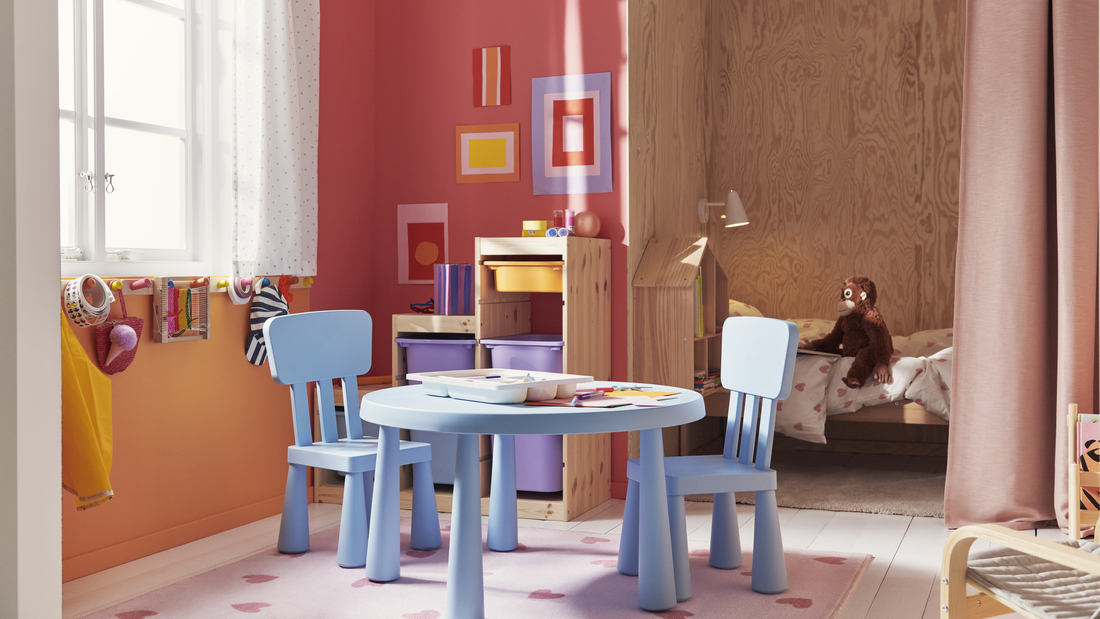
At 1 year old, children become increasingly active in exploring their surroundings through movement, touch, sounds, and interaction. The right educational toys can serve as a playtime tool while providing stimulation that supports their stage of development.
When choosing toys, consider the child’s age, safety, and abilities to ensure playtime remains enjoyable. Here are some recommended educational toys for 1-year-olds, along with tips for choosing them, that can serve as a reference for parents.
Every child develops at a different pace, so developmental milestones at 1 year old may be reached at different times. Choose safe, age-appropriate toys and give your child opportunities to learn through exploration and interaction with parents.
Recommended educational toys for 1-year-olds at IKEA
Educational toys can serve as both play and learning tools to develop motor, sensory, cognitive, and creative skills. Toys should be appropriate for the child’s age to ensure the stimulation provided remains safe and matches their abilities.
IKEA offers a variety of educational toys designed to help children explore their surroundings through play. Here are several recommendations to consider.
1. FABLER BJÖRN soft toy
FABLER BJÖRN is a soft bear toy with an appealing shape that is comfortable to cuddle. Its soft texture and contrasting colors can help stimulate a child’s senses during play.
The soft toy can also become a play companion that helps children recognize shapes, textures, and expressions. The product has undergone safety testing, making it suitable for accompanying children during playtime.

2. UPPSTÅ stacking cups
UPPSTÅ Stacking Cups can be used for various activities, such as stacking, knocking down, rebuilding, and playing with water. These activities help develop hand-eye coordination and fine motor skills.
Stacking games also introduce simple concepts of size, position, and cause and effect. The UPPSTÅ series features forest-themed shapes and figures that can make children’s exploration more engaging.

3. UPPSTÅ hammering toy
UPPSTÅ Hammering Toy encourages children to hammer the pegs using a toy hammer. These repetitive movements can help develop fine motor skills and hand-eye coordination.
The colors, textures, and sounds produced during play provide an engaging sensory experience. Children can also learn to control their hand movements through this simple and enjoyable activity.

4. UPPSTÅ bead maze
UPPSTÅ Bead Maze features a tree-shaped track that encourages children to move the beads. This activity helps develop fine motor skills while introducing simple concepts through movement and position.
Its natural shapes and theme make the toy more engaging for children. It can also serve as a tool for developing thinking skills and simple problem-solving abilities.

5. GRÖNFINK play book
GRÖNFINK Play Book features interactive pages with cute characters and materials with different textures. Children can touch, look at, and explore each part of the book for a sensory experience.
The differences in patterns, sounds, and materials help stimulate the senses while supporting children’s motor skills. Characters from the GRÖNFINK collection can also accompany babies during various activities at home or while traveling.

Read also: Children's toys to accompany growth and development and play moments with family
Key developmental milestones for 1-year-olds
Every child develops at a different pace, so abilities at 1 year old may vary from one child to another. In general, children in this age range may begin to develop the following abilities:
-
Gross motor skills: Crawling faster, standing while holding onto something, walking while holding onto furniture, and attempting their first steps.
-
Fine motor skills: Becoming more skilled at using their thumb and index finger to pick up objects, putting objects into containers, stacking objects, and attempting to hold a spoon.
-
Sensory skills: Actively exploring objects with their hands, mouth, and eyes while showing interest in textures, sounds, colors, and changes in light.
-
Cognitive skills: Beginning to understand that objects still exist even when they cannot be seen and becoming interested in cause-and-effect activities, such as pressing a button to produce a sound.
-
Language and communication: Beginning to babble as if having a conversation, saying one or two meaningful words, understanding simple instructions, and using gestures such as pointing or waving.
-
Social-emotional skills: Beginning to show affection, experiencing separation anxiety, becoming cautious around strangers, and imitating simple activities around them.
The importance of age-appropriate toys for child development
Toys that are not age-appropriate can pose safety risks and may cause children to become frustrated during play. Small parts can pose a choking hazard, while toys that are too complicated may cause children to lose interest.
Age-appropriate toys provide stimulation based on the skills children are developing. Playtime can also build confidence, encourage exploration, and create opportunities for parents and children to strengthen their bond.
How to choose safe toys for 1-year-olds
Safety is a top priority when choosing toys for 1-year-olds who are still actively exploring objects with their hands and mouths. Consider the following before purchasing a toy:
-
Choose toys that are larger than the child’s mouth.
-
Use toys made from safe materials that do not contain harmful substances.
-
Check for the SNI label or international safety standards such as EN71 and ASTM, if available.
-
Avoid small detachable parts, sharp edges, or overly long strings.
-
Choose toys that are easy to clean and check their condition regularly.
-
Choose toys based on the child’s interests and personality without relying on gender stereotypes.
-
Consider the toy’s size so it can be stored easily within the available space at home.
Tips for educational playtime with children at home
Playing with children does not require complicated activities or a large number of toys. Parents can follow their child’s interests while providing stimulation through conversation, movement, and simple exploration.
You can try the following tips:
-
Follow the child’s interests and abilities without forcing an activity.
-
Name the objects or activities the child is currently exploring.
-
Praise the child’s effort and process when trying something new.
-
Rotate toys every few days to prevent boredom.
-
Prioritize direct interaction and limit screen time.
-
Clean toys and play areas regularly.
-
Have short play sessions of around 10–20 minutes on a regular basis.
-
Encourage the child to tidy up the toys after playing.
-
Give the child opportunities to try things independently while remaining under supervision.
Read also: Creative Educational Games for Toddlers: Play While Sharpening the Mind
Common mistakes to avoid when choosing toys for children
Choosing toys should not be based solely on attractive designs or popular trends. Several simple mistakes can make toys less beneficial or even increase risks for children.
-
Buying based on trends: Not every toy is suitable for every child. Always check the recommended age and safety features before purchasing.
-
Providing too many toys: Use a toy rotation system so children do not feel overwhelmed by too many choices.
-
Letting children play alone: Set aside time to accompany and interact with your child.
-
Ignoring signs of boredom or frustration: Children may lose interest in a toy over time. When this happens, simplify the game or switch to another activity.
-
Allowing damaged or dirty toys: Check the condition of toys and clean them regularly.
-
Expecting instant development: Provide consistent stimulation and allow children to develop at their own pace.
-
Comparing children with others: Focus on your child’s own progress and abilities. Comparisons can make children feel less confident.
Choose 1-year-old toys that encourage exploration with IKEA
Toys for 1-year-olds should be safe, age-appropriate, and able to encourage active exploration. Playtime also becomes more meaningful when parents participate and interact with their little ones.
IKEA offers a variety of children’s toys that can support play and learning based on your child’s needs. Discover more children’s toys at IKEA.co.id and choose products that match your child’s age and abilities.
FAQ
Suitable toys include large blocks, stacking cups, interactive books, bead mazes, and toys that develop hand-eye coordination. Choose products that match the child’s abilities and meet applicable safety standards.
One-year-olds can be introduced to simple puzzles with large pieces and only a few pieces. Avoid puzzles with small pieces that could pose a choking hazard.
There is no fixed playtime duration because every child has different interests and abilities. Short sessions of around 10–20 minutes can be a good option as long as the child remains interested and enjoys the activity.
Educational toys are not the only factor that determines a child’s intelligence. Toys serve as a form of stimulation, while interaction, communication, environment, nutrition, and everyday experiences also play important roles in child development.
Toys should be replaced or discontinued when they are damaged, have loose parts, or are no longer appropriate for the child’s abilities. Toys that remain safe and can be used in new ways do not need to be replaced immediately.