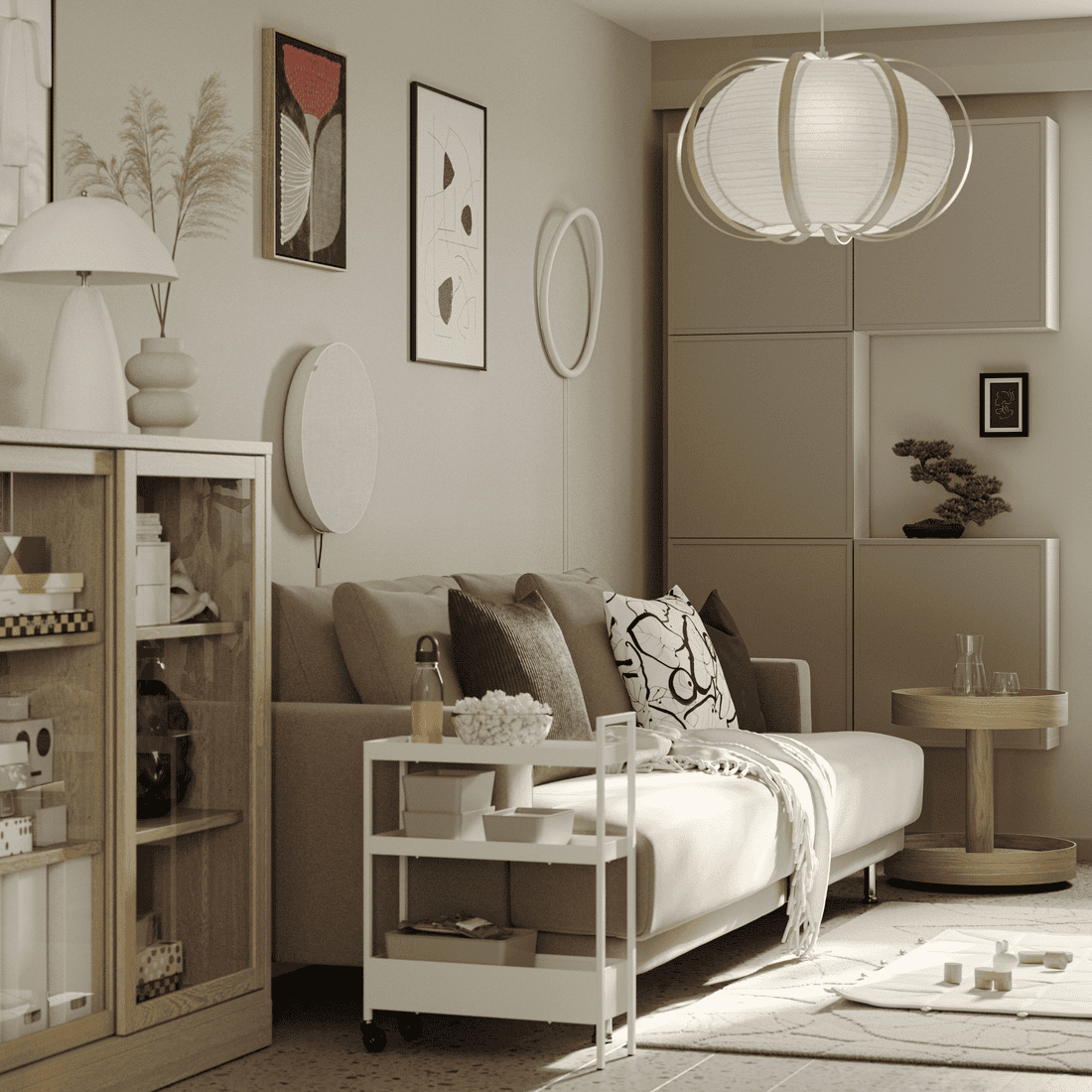
A modern minimalist TV stand for a small space is a compact media unit that supports the TV, stores everyday items, and keeps cables easier to manage. This guide compares 10 IKEA options by size, storage type, materials, cable access, and style.
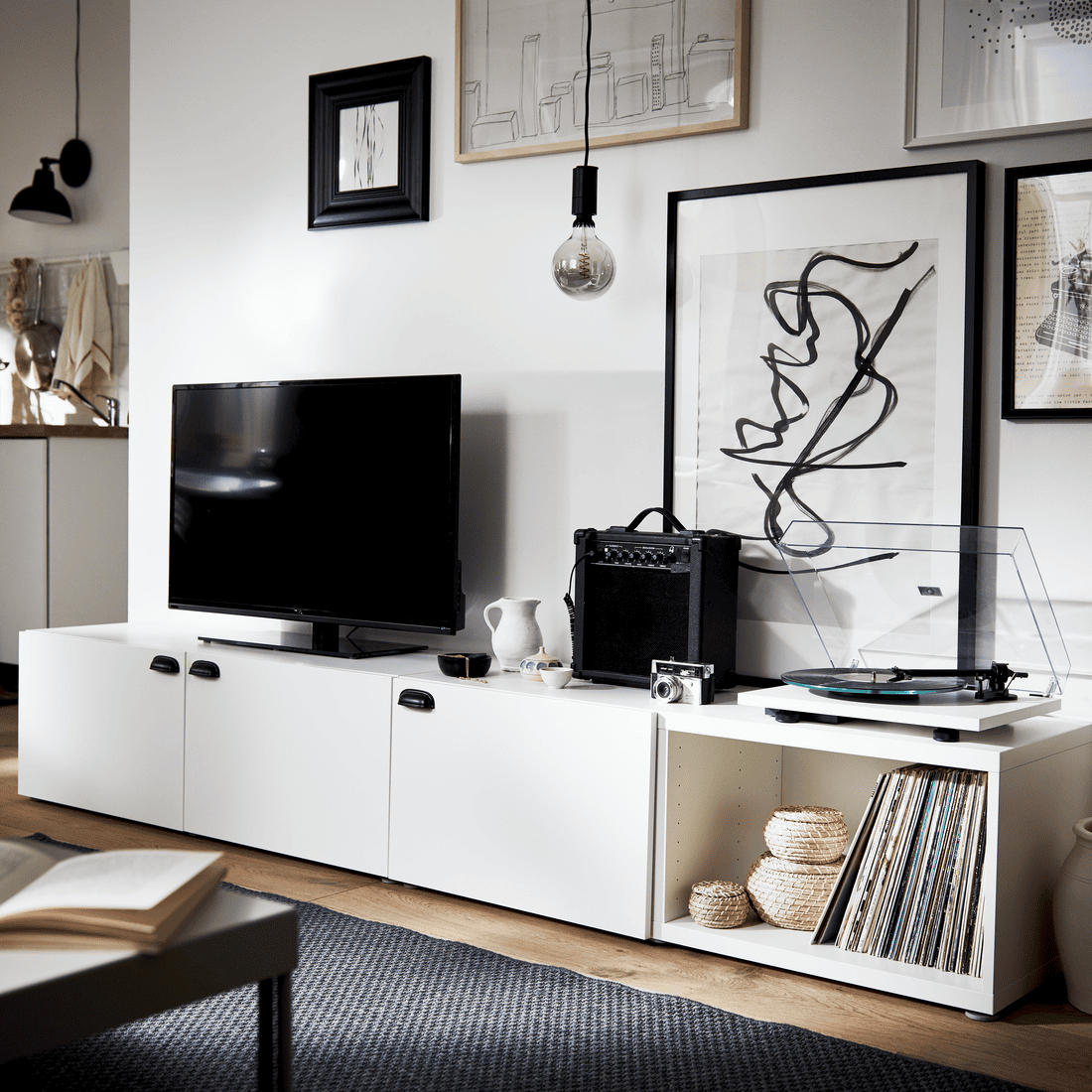
Caption: A modular TV cabinet like the BESTÅ series keeps media devices organized while maintaining a clean, clutter-free look.
What makes a TV stand feel right in a small space?
A TV stand feels right in a small space when it supports the TV, keeps cables easier to route, and gives remotes or media devices a place to return to.
A few simple checks can make it easier to find the right fit:
- Width: a little open space on the left and right can help the TV area feel balanced.
- Depth: a cabinet that does not come too far forward can keep the seating area easier to use.
- Storage: remotes, cables, and media devices are easier to manage when they have a regular spot.
The TV area often fills up slowly. A remote moves to the sofa, a cable shows on the floor, and the router needs a place near the outlet. A TV cabinet that fits the space can help these small things return to their place after use.
TV stand, TV cabinet, credenza, or nightstand: what is the difference?
The difference between a TV stand, TV cabinet, credenza, and nightstand is simple: a TV stand holds media items, a TV cabinet adds storage, a credenza works as low display storage, and a nightstand serves as smaller side storage.
- TV stand: a piece of furniture for a TV, router, small speaker, or media device.
- TV cabinet: a TV unit with storage, such as drawers, doors, shelves, or compartments.
- Credenza: a long, low cabinet often used for storage or display.
- Nightstand: a small table usually placed beside a bed or sofa, sometimes used as extra storage.
Not every TV area needs extra furniture. One cabinet can hold the items you reach for most, like remotes, cables, and media devices, and the room may already have what it needs.
Modern minimalist TV stands for small spaces: size and storage options
Here are modern minimalist TV stand recommendations based on size and open or closed design, including a few combination options.
| Product | Main size | Storage type | Helps create |
|---|---|---|---|
| LACK | 90x26x45 cm, 120x35x36 cm, 160x35x36 cm | Open shelf | A simple, open TV setup with several size options |
| BESTÅ | Starts from 120x40x38 cm | Modular, open or closed | A flexible TV area that can adapt as storage needs change |
| FJÄLLBO | 100x36x54 cm or 150x36x54 cm | Open storage and mesh doors | A TV area with an industrial touch and easy cable access |
| BRIMNES | Starts from 120x41x53 cm | Closed drawers | A less cluttered surface, with drawers for remotes and small items |
| KALLAX | 147x60 cm or 147x39x78 cm | Cube compartments | A TV area with space for books, boxes, and display pieces |
| VIHALS | 146x37x50 cm | Simple white cabinet | A calm, easy-to-match setup for a small living room |
| BYÅS | 160x42x45 cm | Open and closed storage | A clean, modern TV area with visible and hidden storage |
| SKRUVBY | 156x38x60 cm | Cabinet with wood-look accent | A warmer TV area with a soft wood-look detail |
| BOASTAD | 121x42x45 cm | Glass doors and cable storage | A more defined TV area with a compact shape |
| LACK/KALLAX | 224x39x147 cm | Vertical combination | A fuller TV wall with space for display, storage, and media items |
1. LACK, a low TV stand with open shelving
LACK is a low TV stand with open shelving and size options from 90x26x45 cm to 160x35x36 cm. It can help create a simple TV setup with space for the TV, a router, and one or two small devices.
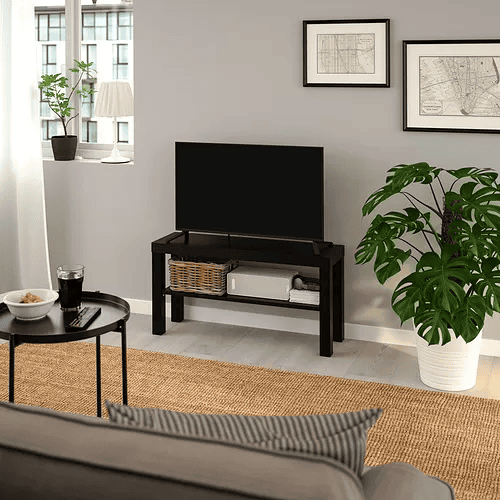
The 90 cm version is only 26 cm deep, so it does not take up much floor space in front of the TV wall. If the wall is longer, the 120 cm or 160 cm version gives a little more surface space without making the TV area feel too full.
2. BESTÅ, a modular TV cabinet with storage options
BESTÅ is a modular TV cabinet that starts from 120x40x38 cm and can be adapted with doors, drawers, legs, or longer combinations. It can help create a TV area that feels more flexible, especially when storage needs may change over time.
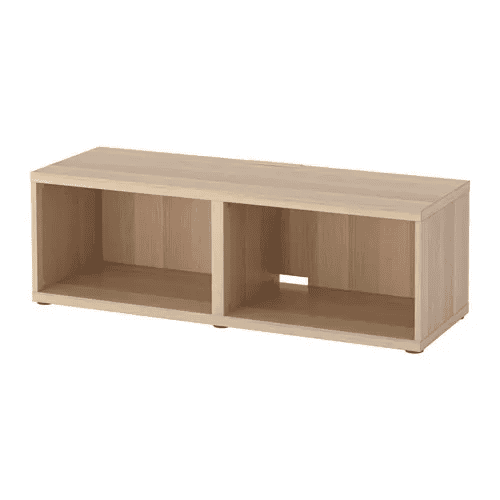
A TV area often grows little by little. It may start with a TV and router, then later include extra cables, a small speaker, or a game console. BESTÅ gives the setup a simple starting point that can adjust as the room changes.
3. FJÄLLBO, an industrial TV cabinet with mesh doors
FJÄLLBO is an industrial-style TV cabinet with a black metal frame and mesh metal doors. It can help create a TV area with more character, while still keeping space open for media devices and cables.
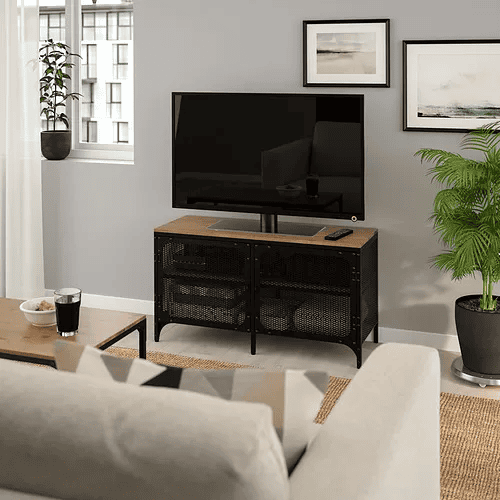
Mesh metal doors allow remote signals to reach electronic devices. The open back makes it easier to guide cables toward the wall. The 100 cm version can suit a smaller room, while the 150 cm version gives more surface space for the TV and extra devices.
4. BRIMNES, a white TV cabinet with large drawers
BRIMNES is a TV cabinet with large drawers and size options starting from 120x41x53 cm. It can help when remotes, cables, game controllers, toys, or small accessories often end up around the TV.
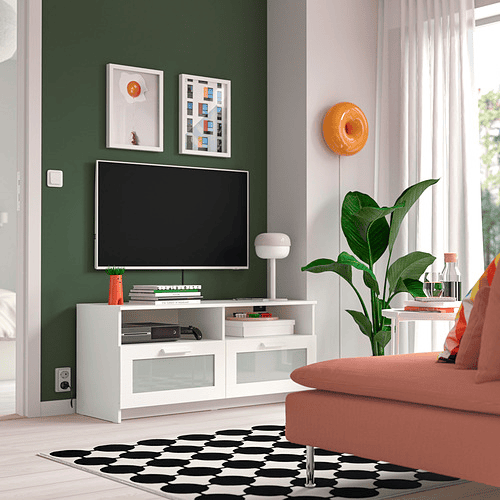
In a family room, small things tend to move around quickly. A drawer gives them one place to return to after movie time, so the top of the cabinet does not fill up as fast.
5. KALLAX, a cube TV unit for storage and display
KALLAX is a TV unit with cube compartments and size options of 147x60 cm or 147x39x78 cm with an underframe. It can help create a TV area with room for books, media devices, storage boxes, or a few favorite display pieces.
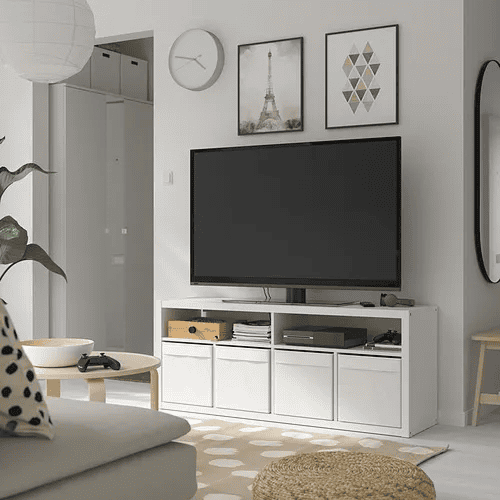
KALLAX can help when there is not much room for another cabinet. Some cubes can hold boxes or baskets, while others can show books, a small plant, or pieces that make the TV area feel more personal.
6. VIHALS, a white TV stand with a compact size
VIHALS is a white TV stand sized 146x37x50 cm, with a simple shape and a not-too-deep footprint. It can help create a calm TV area that blends easily into a small living room.
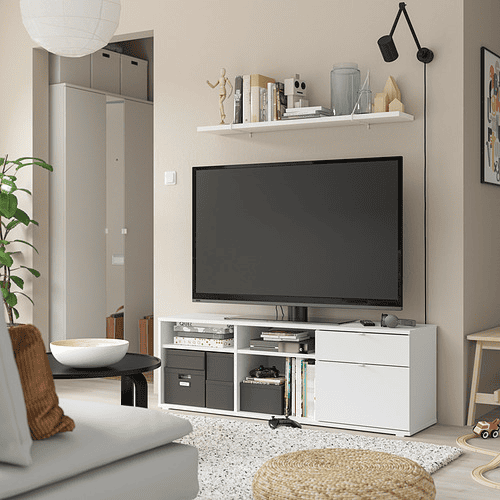
VIHALS can sit quietly in a room used for many things, like a living room connected to a dining area or a corner of an apartment. It gives the TV area a clear function without asking for too much attention.
7. BYÅS, a high-gloss TV stand with open and closed storage
BYÅS is a high-gloss TV stand sized 160x42x45 cm, with both open and closed storage. It can help create a clean, modern TV area where frequently used devices stay easy to reach, while cables or accessories can go behind a door.
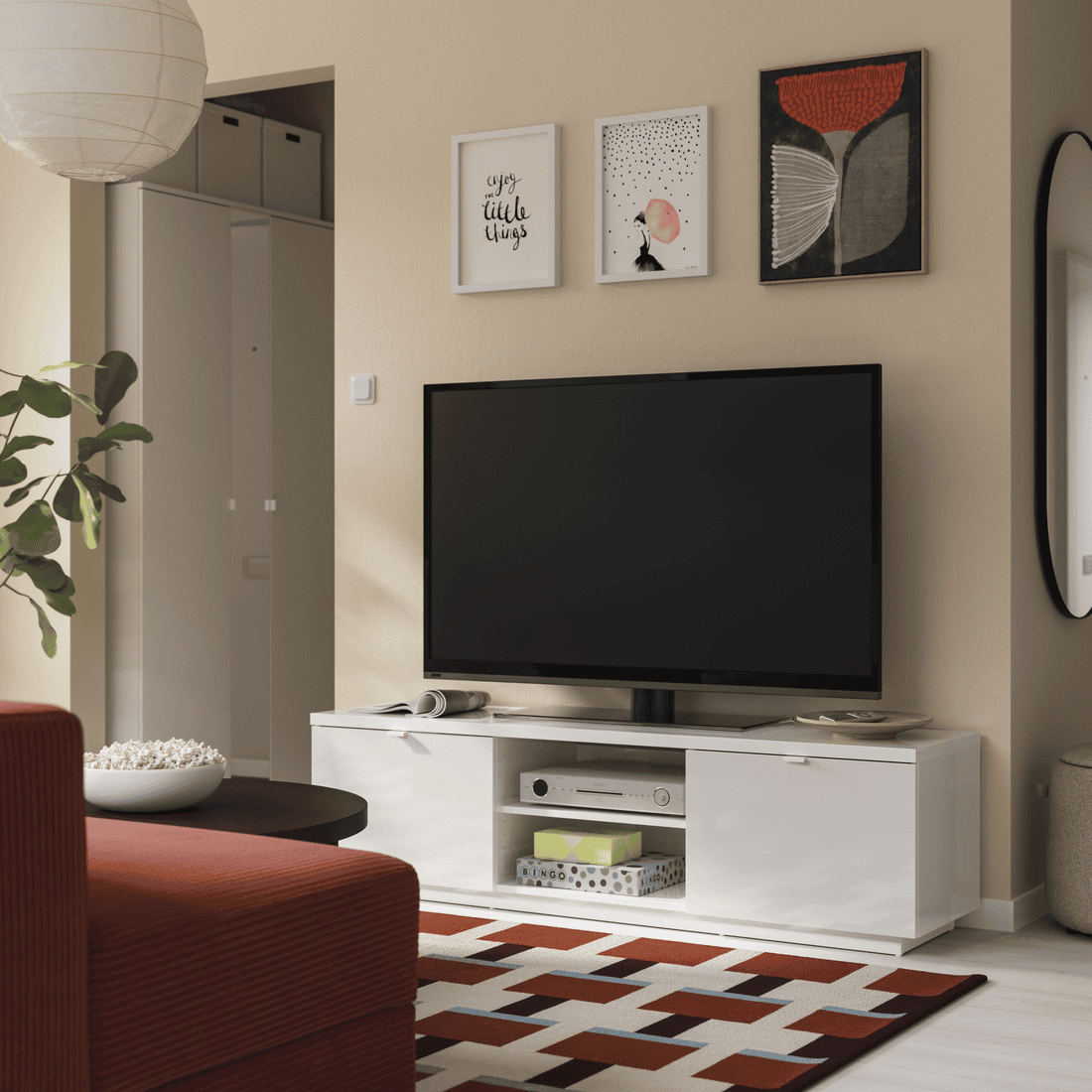
The open section can hold a game console or media player. The closed section can hold spare cables, TV accessories, or other small items. It may be worth checking the 42 cm depth against the space in front of the cabinet.
8. SKRUVBY, a white TV stand with a wood-look accent
SKRUVBY is a TV stand sized 156x38x60 cm, with an oak-effect top panel and profiled edges. It can help create a warmer TV area while keeping the overall look simple.
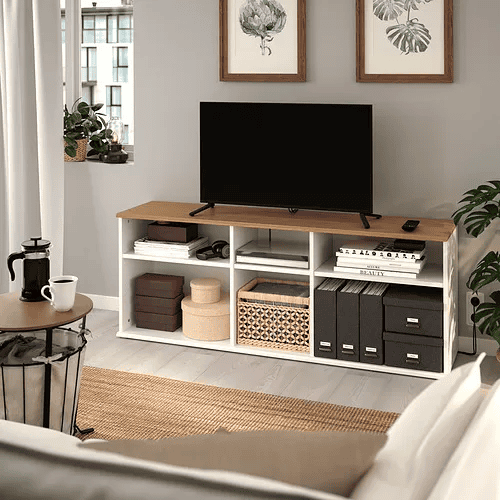
In a room with a lot of white furniture, a wood-look accent can make the TV area feel warmer. Since it is 60 cm high, it is worth checking the viewing position from the sofa.
9. BOASTAD, a black TV stand with glass doors
BOASTAD is a TV stand sized 121x42x45 cm, with a black finish, oak veneer, glass doors, and mesh cable storage. It can help create a more defined TV area while still leaving room for devices and cables.
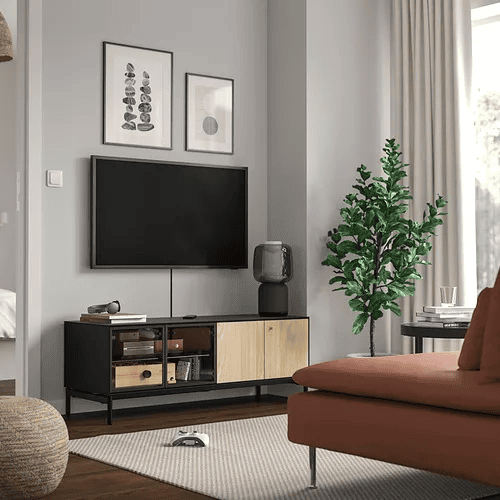
Glass doors let remote signals through, while mesh cable storage helps keep cables together. At 121 cm wide, BOASTAD is not as long as some other TV cabinets. Its 42 cm depth is still worth checking if there is a sofa, coffee table, or walkway in front.
10. LACK/KALLAX, a TV combination with shelves and drawers
LACK/KALLAX is a TV storage combination sized 224x39x147 cm, with a TV bench, wall shelves, shelving unit, shelf inserts, drawers, and doors. It can help create a fuller TV wall with space for display, storage, and everyday media items.
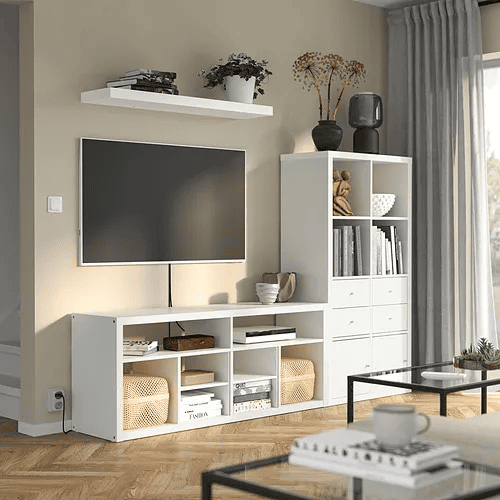
This is more than a LACK or KALLAX variant. It is a fuller wall setup. Before choosing it, measure the wall and the floor space in front so the area still feels easy to use.
How to choose the right TV stand size for a small space
A TV stand or TV cabinet for a small space is easier to choose when you check four things: depth, width, height, and space for drawers or doors to open. These checks can help you picture how the cabinet will feel in everyday use, not just how it looks on the wall.
Check the cabinet depth first
Cabinet depth is the distance from the front of the cabinet to the back. In a small room, this matters because it shows how much floor space the cabinet uses from the wall toward the sofa.
For example, a 40 cm deep cabinet comes out about 40 cm from the wall. If there is a coffee table or walkway in front, it may help to see whether there is still space to walk, open drawers, and guide cables behind the cabinet.
Match the cabinet width to the wall
Cabinet width is the measurement from side to side. For a shorter wall, a 90 to 120 cm cabinet is often easier to place. For a wider wall, a 150 to 180 cm cabinet can give extra room for a small speaker, decor, or a storage box.
Leaving a little open space on both sides can make the TV area feel less crowded, especially when the TV sits on top of the cabinet.
Choose a comfortable viewing height
Cabinet height affects where the screen sits when viewed from the sofa, chair, or bed. A low cabinet can make the wall feel more open, but the screen should still feel comfortable to watch.
The simplest check is to sit where you usually watch TV. If you need to look too far down or tilt your head up, the TV height may need adjusting.
Leave room for drawers and doors to open
Drawers and cabinet doors need space in front. Before choosing a cabinet, picture the drawers pulled out or the doors opened with the coffee table, rug, or walkway already in place.
If the space in front is limited, open shelving or simple-access storage may feel easier. If you prefer closed storage, choose a size that still lets you open drawers, put remotes away, and guide cables toward the back.
What to check before choosing a TV cabinet
Cabinet width
Cabinet width
- Rule of thumb
- Choose a width that still leaves some space on the left and right.
- Helps create
- A TV area that feels more balanced on the wall.
- Worth noting
- A very wide cabinet can make the wall feel full, even when the cabinet itself is low.
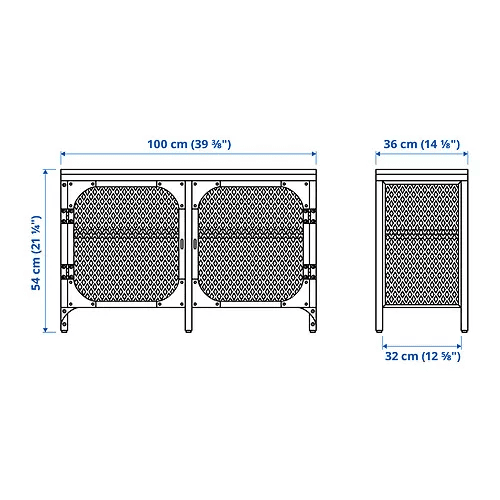
Cabinet depth
Cabinet depth
- Rule of thumb
- About 26 to 40 cm deep is usually easier for small spaces.
- Helps create
- More comfortable space between the TV area, seating, and walkway.
- Worth noting
- The deeper the cabinet, the more floor space it uses from the wall toward the sofa.
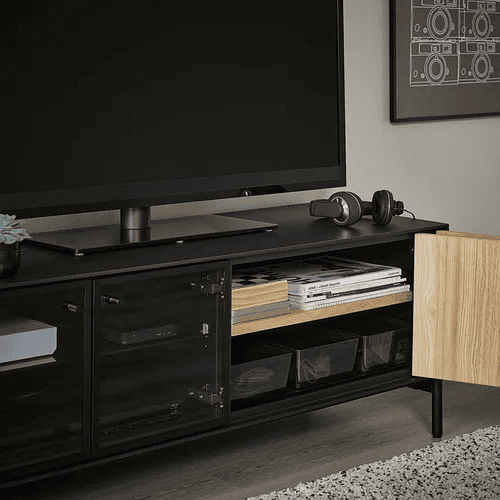
Closed storage
Closed storage
- Rule of thumb
- Doors or drawers can help when there are several small items to store.
- Helps create
- A calmer TV surface, especially when remotes, cables, game consoles, routers, and media accessories need a place.
- Worth noting
- Doors and drawers still need enough space in front to open comfortably.
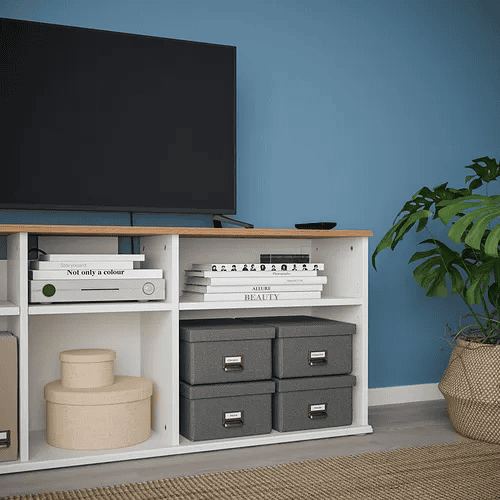
Open shelving
Open shelving
- Rule of thumb
- Open shelving can help when you store only a few items and want them easy to arrange.
- Helps create
- A TV area with room for media devices, books, small plants, or display pieces.
- Worth noting
- Items on open shelves are easier to see, so small boxes or organizers can help keep them from spreading out.
Open or closed TV cabinet: which one fits your space?
An open TV stand is ideal if you have fewer devices and want easy access. A closed TV cabinet is better if you have many cables, controllers, or accessories that you want to keep hidden.
Pilih rak terbuka jika ingin area TV terasa lebih lega
An open shelf like LACK or KALLAX helps keep the room looking light because it doesn't block the visual space. You can use it to hold media players, books, speakers, or plants.
To prevent small items from scattering, you can use storage boxes or cable organizers. This keeps the shelves functional without looking cluttered.
Pilih kabinet tertutup jika banyak barang kecil
Closed storage like BRIMNES or BESTÅ helps store remotes, extra cables, controllers, and toys behind doors or drawer fronts. This keeps the surface clean and keeps everyday clutter out of sight.
This is especially helpful if your TV room is also your main living area. Once you're done watching, everything can be tucked away so the room is ready for other activities.
Combine open and closed shelving for a mixed setup
Sometimes you need both. Frequently used devices can go on open shelves, while spare cables, manuals, or controllers stay behind closed doors.
Combinations like FJÄLLBO, KALLAX, or LACK/KALLAX provide a good balance. Make sure the unit size fits your room so everyday paths stay open.
How to keep a small TV area organized
A small TV area is much easier to keep clean when cables, remotes, and accessories have a dedicated home. Start with a few simple steps: store what you use, hide the cords, and use the wall if floor space is limited.
1. Keep remotes and cables together
Start with the items that get misplaced most often. Remotes, chargers, HDMI cables, and adapters can go into a drawer, a small box, or a dedicated compartment. This makes them easy to find and easy to put away.
2. Use boxes for open shelves
If you have open shelves like KALLAX, boxes or baskets can keep smaller items from looking messy. Choose boxes that fit the shelves perfectly. For example, have one box for gaming gear, one for cables, and one for media disks.
3. Clear the top surface
Keep the top of your TV stand relatively empty. Try to display just one or two decorations, like a small plant, a photo frame, or a small table lamp. Having a little empty space helps the entire TV wall feel less crowded.
4. Use the wall to save floor space
If you don't have much floor space, let the walls help. Hanging shelves, wall cabinets, or mounting the TV directly on the wall can free up the top of your media bench. Make sure to check wall strength and load limits before installing wall units.
Frequently asked questions about modern minimalist TV stands
Find the right TV cabinet for your space