Bedroom wardrobes are usually 31 to 79 in (80 to 200 cm) wide, 22 to 24 in (55 to 60 cm) deep, and 71 to 87 in (180 to 220 cm) high. This guide covers 2-door, 3-door, 4-door, and modular wardrobe sizes, plus how to check your room before choosing.
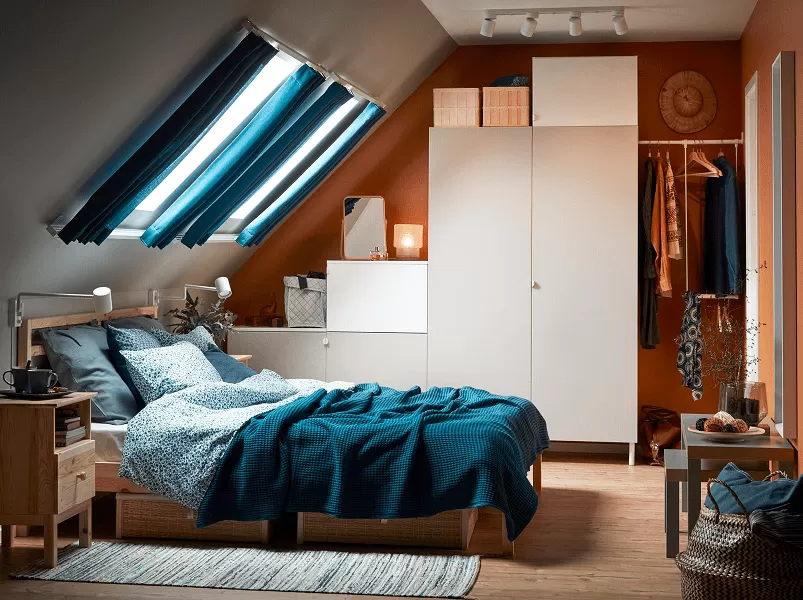
Wardrobe size chart: 2-door, 3-door, 4-door, and modular
A 2-door wardrobe is usually about 31 to 39 in (80 to 100 cm) wide, 22 to 24 in (55 to 60 cm) deep, and 69 to 79 in (176 to 201 cm) high. A 3-door wardrobe is often about 47 to 63 in (120 to 160 cm) wide, while a 4-door wardrobe can start around 63 to 79 in (160 to 200 cm) wide or more.
These numbers are a helpful first step before you look at the bedroom wall, the space in front of the wardrobe, and the clothes you need to store.
| Wardrobe type | Common width | Common depth | Common height | Works well for |
|---|---|---|---|---|
| 2-door wardrobe | 31 to 39 in (80 to 100 cm) | 22 to 24 in (55 to 60 cm) | 69 to 79 in (176 to 201 cm) | One person, a smaller bedroom, child’s room, or guest room |
| 3-door wardrobe | 47 to 63 in (120 to 160 cm) | 22 to 24 in (55 to 60 cm) | 71 to 87 in (180 to 220 cm) | One person with more clothes, or two people with lighter storage needs |
| 4-door wardrobe | 63 to 79 in (160 to 200 cm) | 22 to 24 in (55 to 60 cm) | 71 to 87 in (180 to 220 cm) | Two people or a larger amount of clothing |
| Modular wardrobe | Starts with a main frame, then grows from there | Depends on the system | Depends on the system | Storage needs that may change over time |
This chart is not a rule for every bedroom. Use it as a starting point, then compare it with the wall space you have, the wardrobe depth, the space in front, and the way the doors open. A few inches can make a real difference when you walk past the bed or reach for clothes on a busy morning.
How to measure a wardrobe that fits your bedroom
Measuring a wardrobe that fits your bedroom starts with available wall width, depth from the wall into the room, ceiling height, front clearance, and door movement. These five checks show whether the wardrobe can fit the room and still be easy to open, reach into, and walk around every day.
Before choosing a wardrobe style, check:
- The wall width where the wardrobe will stand
- The room height from floor to ceiling
- The space between the wardrobe area and the bed
- The position of the bedroom door, window, light switch, and outlet
- The standing room in front of the wardrobe
Once these are written down, mark the wardrobe footprint on the floor with painter’s tape. Then walk around it the way you would on a regular morning, from the bed to the door or from the wardrobe to the mirror. It does not need to feel perfect right away. This small check helps you notice whether the wardrobe will be easy to open, reach, and pass by every day.
Bedroom checklist before choosing a wardrobe
A bedroom checklist before choosing a wardrobe should include the available wall area, room height, distance to the bed, door or window position, and the space in front of the wardrobe. These checks show whether the room can work with a 2-door wardrobe, sliding doors, a taller frame, or a slimmer design.
Before choosing a wardrobe style, check:
- The width of the area where the wardrobe will stand
- The room height from the floor to the ceiling
- The distance between the wardrobe area and the bed
- The position of the bedroom door, window, light switch, and outlet
- The standing room in front of the wardrobe so the doors can open and clothes are easy to reach
When the measurements are written down, mark the wardrobe footprint on the floor with painter’s tape. Walk around it the way you would on a regular morning, from the bed to the door or from the wardrobe to the mirror. It does not need to feel perfect right away. This small check simply helps you notice whether the wardrobe will be easy to open, reach, and pass by every day.
How to measure a wardrobe with a tape measure
Use a tape measure to check the width, depth, height, and front clearance of the space where your wardrobe will go.
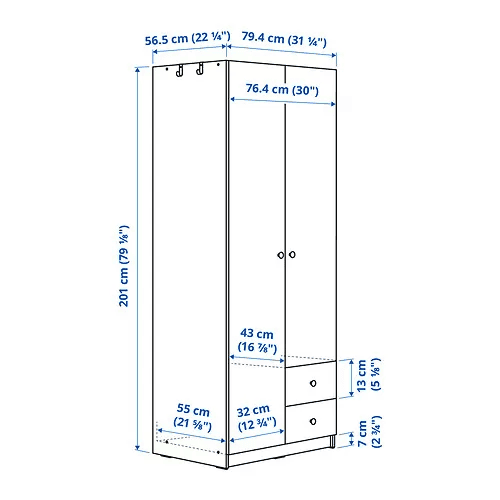
Caption: BRUKSVARA wardrobe
For this example, we'll use the BRUKSVARA wardrobe, which is 31.3 in (79.4 cm) wide, 22.2 in (56.5 cm) deep, and 79.1 in (201 cm) high. By comparing these product measurements with the measurements you take in your bedroom, you can quickly see whether the wardrobe will fit comfortably and leave enough room to move around.
Once you've measured the space, use those numbers as a guide through the steps below. This makes it easier to visualize how much wall space the wardrobe will use, how far it extends into the room, and whether there is enough clearance above and in front for everyday use.
1. Measure the width of the wardrobe area
Using a tape measure, check the space from left to right where the wardrobe will stand. In the BRUKSVARA example, the wardrobe is 31.3 in (79.4 cm) wide, so the available area should be at least about 32 in (80 cm) wide.
For example, if your tape measure shows an available width of 47 in (120 cm), placing a wardrobe that is about 32 in (80 cm) wide leaves about 16 in (40 cm) on the side. That extra space can help the wardrobe fit more comfortably near a door, light switch, curtain, or nearby furniture.
2. Measure the depth from the wall into the room
Use a tape measure to check the distance from the wall toward the bed or open area of the room. The BRUKSVARA wardrobe has a depth of 22.2 in (56.5 cm), meaning it extends about 22 in (57 cm) from the wall.
For example, if your measurement from the wall to the side of the bed is 51 in (130 cm), subtract about 22 in (57 cm) for the wardrobe depth. That leaves about 29 in (73 cm) in front of the wardrobe, giving you room to stand, open the doors, and access your clothes comfortably.
3. Measure the height from floor to ceiling
Use a tape measure to check the distance from the floor to the ceiling, then compare it with the wardrobe height. In this example, the wardrobe is 79.1 in (201 cm) high, so the room needs to be taller than 79 in (201 cm).
For example, if your tape measure shows a ceiling height of 98 in (250 cm), there is about 19 in (49 cm) of space above the wardrobe. This extra clearance can make installation easier and help prevent the wardrobe from feeling cramped against the ceiling.
4. Measure the space needed for the wardrobe doors
After measuring the wardrobe area, use your tape measure to check the distance from the front of the wardrobe location to the bed, desk, or opposite wall. This helps you determine whether the doors can open comfortably.
If the front clearance measures about 28 to 35 in (70 to 90 cm), there is usually enough room to stand and access the wardrobe. If your measurement is under 28 in (70 cm), a sliding-door wardrobe may be a better option because it does not require additional swing space.
5. Mark the wardrobe size on the floor
Once you've measured the room, use painter's tape to outline the wardrobe footprint on the floor. For the BRUKSVARA example, mark approximately 31.3 in (79.4 cm) for the width and 22.2 in (56.5 cm) for the depth.
Then walk around the taped outline as you normally would. Move between the bed, wardrobe area, and bedroom door to see how the space feels. This simple step helps turn your tape-measure readings into a more realistic picture of how the wardrobe will fit into your daily routine.
Wardrobe size references by storage needs
Wardrobe size by storage needs starts with the number of users, hanging clothes, folded clothes, and extra items such as bed linens, bags, or accessories.
A 2-door wardrobe can be enough for one person with everyday clothing, while a 63 to 79 in (160 to 200 cm) wardrobe or modular system is easier to divide for two people or more storage.
| Storage need | Wardrobe size to consider | Notes |
|---|---|---|
| One person with everyday clothes | 31 to 39 in (80 to 100 cm) | Enough for basic hanging and folded clothes |
| One person with more hanging pieces | 39 to 59 in (100 to 150 cm) | Gives more room for shirts, jackets, dresses, or blazers |
| Two people sharing light storage | 47 to 63 in (120 to 160 cm) | Can be divided by side or by clothing type |
| Two people with more to store | 63 to 79 in (160 to 200 cm) or modular | Easier to organize with hanging space, shelves, and drawers |
Before choosing, sort your items into three groups: hanging clothes, folded clothes, and small items. From there, it becomes easier to see whether a 2-door wardrobe gives you enough room, or whether shelves, drawers, or a wider frame would help. It is not about getting the perfect answer right away. It is just a practical way to understand what your storage needs to do.
How to match wardrobe size with bedroom size
Matching wardrobe size with bedroom size starts with checking the room size, the wall where the wardrobe will go, and the space between the wardrobe and nearby furniture.
As a general guide, rooms under 97 sq ft (9 m²) often work better with a 31 to 39 in (80 to 100 cm) wardrobe, rooms around 97 to 129 sq ft (9 to 12 m²) may fit 39 to 63 in (100 to 160 cm), and rooms over 129 sq ft (12 m²) can often consider 63 to 79 in (160 to 200 cm) or modular storage.
To check if a wardrobe will fit comfortably:
- Measure the room length and width.
- Choose the wall where the wardrobe will stand and measure the available space.
- Check the wardrobe depth so it does not block the walking path.
- Leave about 28 to 35 in (70 to 90 cm) in front of the wardrobe, if possible, so the doors can open and clothes are easy to reach.
- Compare your measurements with the wardrobe size. For example, if the available width is about 39 in (100 cm), a 2-door wardrobe is usually easier to fit than a larger one.
This helps you check not only whether the wardrobe fits the space, but also whether it is comfortable to use every day.
Use this table as a starting point before choosing a wardrobe:
| Bedroom size | What the room may allow | Wardrobe size to consider | What to check |
|---|---|---|---|
| Under 97 sq ft (9 m²) | A more compact wardrobe area | Width 31 to 39 in (80 to 100 cm), depth 22 to 24 in (55 to 60 cm) | Distance to the bed and door clearance |
| 97 to 129 sq ft (9 to 12 m²) | More room for width or extra storage | Width 39 to 63 in (100 to 160 cm), depth 22 to 24 in (55 to 60 cm) | Hanging space, shelves, and drawers |
| Over 129 sq ft (12 m²) | Wider wardrobe or modular storage | Width 63 to 79 in (160 to 200 cm) or modular | Walkway, height, and front clearance |
| Over 129 sq ft (12 m²), shared | More space for divided storage | Width 63 in (160 cm) or more, if possible | Storage space for each person |
| Front space under 28 in (70 cm) | Less room for doors to swing open | Sliding doors or a slimmer wardrobe | Standing room when taking clothes out |
These ranges are only a starting point. A room can still feel different depending on the bed size, door position, windows, and what else lives in the space. So after checking the table, look again at the path you use every day: from the door to the bed, from the bed to the wardrobe, and from the wardrobe to the mirror or laundry basket.
For a shared bedroom, plan the inside before choosing the width
For a shared bedroom, planning the inside before choosing the width helps each person have a clear place for daily clothes, workwear, and accessories. A width of at least 63 in (160 cm), or a modular system, can make the wardrobe easier to divide.
Try sketching the inside before deciding on the final size. One side can hold one person’s clothes, while the other side holds the other person’s. You can also divide by item type: hanging space for pieces that crease easily, shelves for folded clothes, and small drawers for accessories. A little planning here can make busy mornings feel less crowded.
How to choose ready-made, custom, or modular wardrobes
Choosing ready-made, custom-sized, or modular wardrobes starts with the product size, the shape of the room, and whether your storage needs may grow later. Comparing these three things can help you decide which wardrobe type makes sense before looking at finishes, doors, or interior accessories.
| Wardrobe option | Choose it when | Example condition |
|---|---|---|
| Ready-made wardrobe | The available area is wider than the product size | A 47 in (120 cm) area can fit a 31 to 39 in (80 to 100 cm) 2-door wardrobe |
| Custom wardrobe | The room has a shape that needs special sizing | There is a column, sloped ceiling, or door close to the wardrobe area |
| Modular wardrobe | The interior layout may grow or change | Start with a main frame, then add shelves, hanging rails, drawers, or accessories |
Wardrobe options to compare
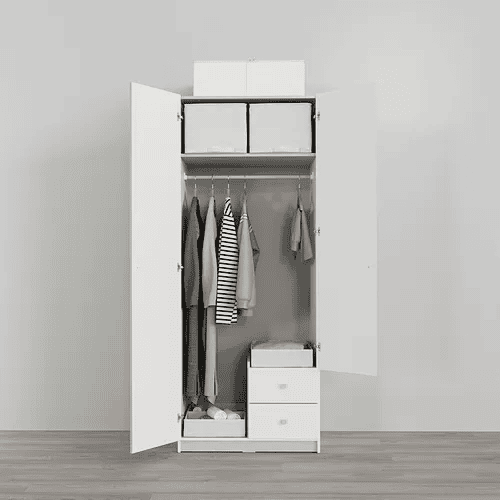
Ready-made wardrobe
Standard ready-to-use option
- Recommended for
- Rooms where the available width, room height, and door clearance match the product dimensions.
- Best for
- Everyday storage, familiar room layouts, or choosing a wardrobe more quickly.
- Watch out for
- Check width, height, depth, door style, and interior layout before buying. When the size feels close, mark it on the floor first so you can picture the space better.
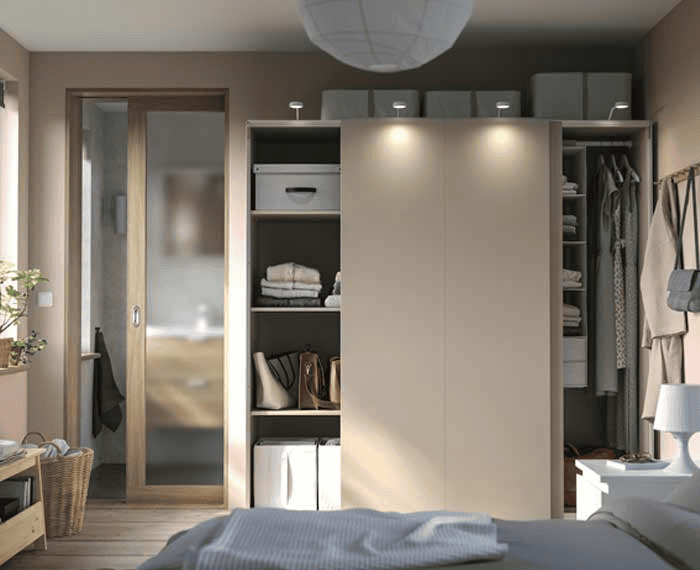
Custom or modular wardrobe
Flexible customizable option
- Recommended for
- Rooms that need more flexible sizing or an interior layout that can be planned more closely.
- Best for
- Using a specific area, adding more hanging space, or arranging shelves and drawers around your storage habits.
- Watch out for
- Keep the wardrobe easy to use. Check hanging height, door direction, front clearance, and top shelves before deciding.
Choose a wardrobe that is easy to use every day
A wardrobe that is easy to use every day starts with three practical checks: available width, a depth of about 22 to 24 in (55 to 60 cm) for hanging clothes, and front clearance of about 28 to 35 in (70 to 90 cm), if possible. After that, check the room height, door direction, and what needs to be stored inside.
Before choosing a ready-made, custom-sized, or modular wardrobe, mark the wardrobe size on the floor with painter’s tape. From there, you can see whether the doors open easily, the path still works, and the wardrobe feels natural to use in your daily routine.
Frequently asked questions about wardrobe sizes
Have a wardrobe size in mind?