
Loose clothing, toys, stationery, cables and hobby supplies can quickly make a home feel cluttered. Giving these belongings a dedicated storage box makes them easier to organise and find.
However, choosing a storage container involves more than selecting the largest capacity.
Consider what you need to store, where the box will be placed, how often it needs to be opened and whether features such as a lid, transparent construction, wheels or stackability would make everyday use easier.
Before choosing a storage box, measure the available space and match the box size to what you need to store. Use transparent boxes for frequently accessed items, lidded boxes to help reduce dust exposure, and stackable or wheeled designs when you want to save space or make storage easier to move.
Here are seven storage box ideas for different areas and organisation needs around the home.
Which Type of Storage Box Is Right for You?
There is no single plastic storage box that is best for every situation.
| Storage type | Main feature | Useful for |
|---|---|---|
| Transparent | Contents remain visible | Frequently accessed belongings |
| Lidded | Covered storage | Documents and accessories |
| Wheeled | Easier to move | Larger or bulkier items |
| Stackable | Uses vertical space | Limited storage areas |
| Foldable | Stores flat when empty | Clothing and wardrobes |
| Modular | Works within a storage system | Children's toys |
Measure the available space before choosing a container, particularly when it needs to fit inside a wardrobe, shelving unit or under a bed.
1. SAMLA Transparent Storage Boxes for Easy Visibility
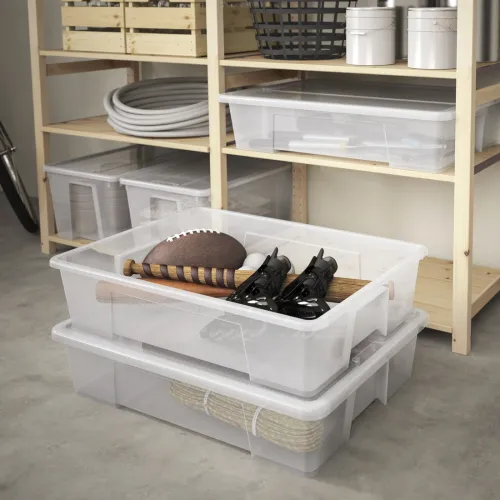
Transparent containers are useful when you want to identify the contents without opening every lid.
A SAMLA transparent storage box can organise household accessories, hobby supplies, seasonal belongings and items that are not used every day.
The transparent construction makes it easier to find a specific box when several containers are stored together.
This makes it particularly practical in wardrobes, utility spaces or internal storage areas.
For even quicker identification, add labels when boxes are positioned with only one side visible.
2. Large SAMLA Storage Boxes for Bulky Items
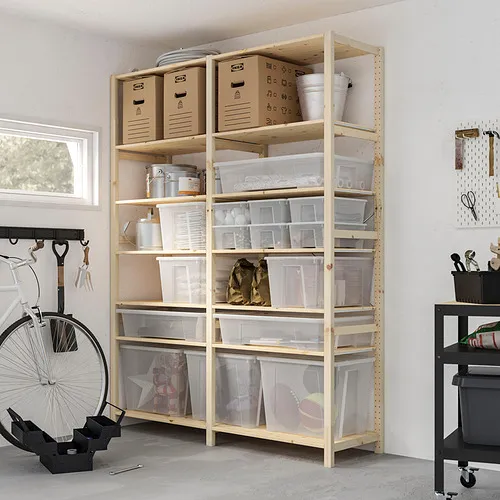
Larger storage boxes are useful when clothes, equipment or household items take up more space.
A large SAMLA storage box with wheels can make bulky contents easier to move because the box does not always need to be lifted.
Wheels are particularly useful when the container needs to be pulled from a storage area from time to time.
Do not choose based only on volume.
Check the external width, depth and height, as well as door openings, shelving dimensions and the route through which the container needs to move.
For large containers, easy access can be just as important as maximum capacity.
3. KUGGIS for Neat Open-Shelf Storage
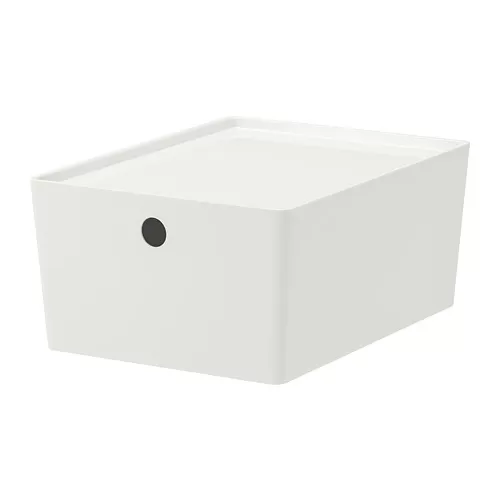
A transparent container is not always the best visual choice.
For shelves that remain visible in a living room, office or workspace, a KUGGIS box with lid can help keep smaller belongings out of sight.
Use it for items such as:
- stationery;
- cables;
- chargers;
- documents;
- small gadgets;
- hobby supplies;
- household accessories.
The closed design can create a calmer appearance than leaving several small objects visible.
Compatible KUGGIS sizes can also support stacking. Always follow the individual product instructions rather than assuming that any number of boxes can be safely stacked.
4. Low Storage Boxes for Under-Bed Space
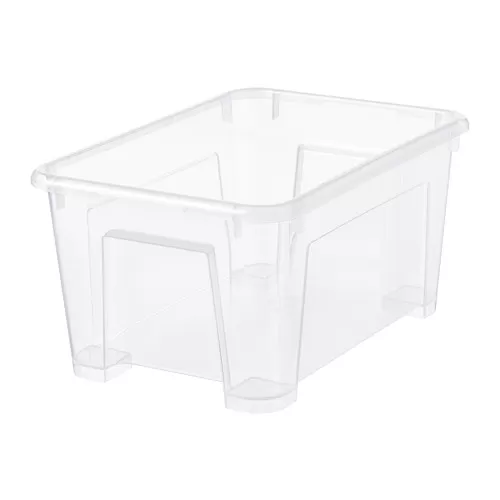
The space beneath a bed can provide valuable storage without using more floor area elsewhere in the room.
A low box is useful for items that do not need to be accessed every day, including:
- seasonal clothing;
- selected textiles;
- sports accessories;
- decorations;
- flat household items.
Transparent storage makes it easier to identify the contents before pulling the container completely out.
Measure the clearance beneath the bed carefully and leave enough room for the box to slide in and out comfortably.
Related read: Smart storage solutions for unused bedroom spaces.
5. SKUBB Foldable Storage for Wardrobes
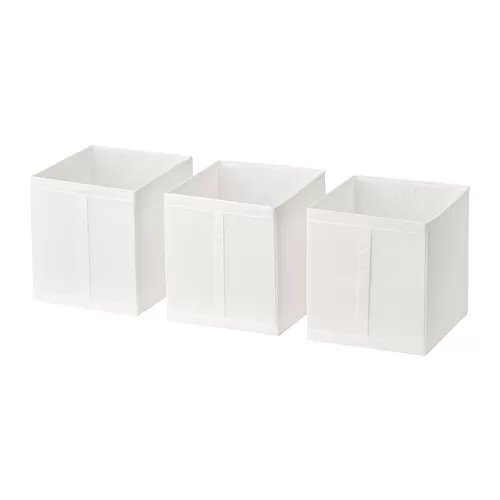
Not every organisation task requires a rigid plastic container.
For lightweight clothes and wardrobe accessories, a foldable storage box can be a more practical solution.
SKUBB storage can be folded flat when it is not being used, helping save space inside the wardrobe.
Use foldable boxes to separate:
- folded clothes;
- sportswear;
- accessories;
- textiles;
- less frequently worn items.
Creating clear groups makes it easier to find one item without disturbing the entire wardrobe.
6. TROFAST Storage Boxes for Children's Toys
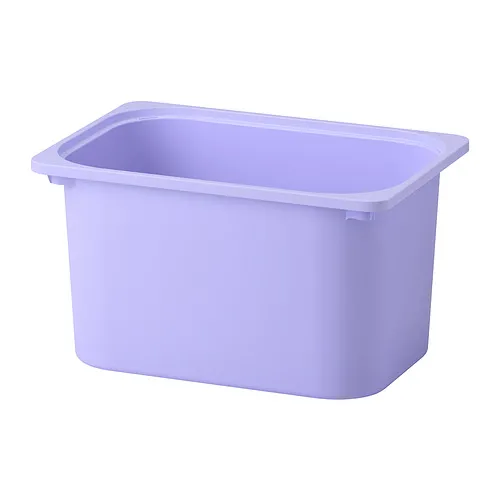
Children's toys come in many shapes and sizes, so a simple storage system can make everyday tidying easier.
TROFAST boxes can separate building blocks, books, creative supplies and different categories of toys.
When paired with the TROFAST system, each category can have a designated place.
Simple labels or visual categories can also help children understand where items belong after playtime.
This makes storage easier to access while preventing toys from spreading across the room.
Related read: Toy storage ideas that encourage children to tidy up.
7. Small Lidded Boxes for Cables, Stationery and Accessories
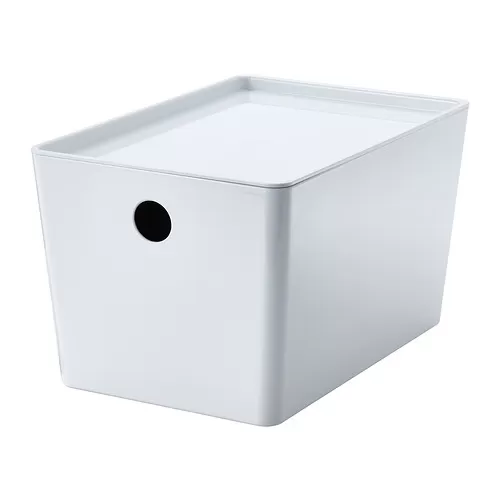
Small objects are often responsible for visual clutter because they easily move between drawers, tables and shelves.
Use small lidded boxes for:
- cables;
- adapters;
- batteries;
- stationery;
- craft supplies;
- electronic accessories;
- small tools.
A smaller KUGGIS box can help keep these belongings grouped together on a shelf or work desk.
Avoid putting every small object in one container. Dividing items by function makes them much easier to retrieve.
Opaque boxes can also benefit from a simple label.
Tips for Choosing the Right Plastic Storage Box
Measure the available space first
Do not compare boxes only by litre capacity.
Measure:
- shelf width and depth;
- wardrobe dimensions;
- under-bed clearance;
- utility storage;
- internal storerooms.
Also allow enough room to remove the lid or pull the box forward.
Choose transparent or opaque storage according to access
Transparent boxes allow you to identify contents quickly.
Opaque containers can create a calmer visual effect on exposed shelving.
The best choice depends on how often the contents need to be accessed and where the box is displayed.
Decide whether you need a lid
A lid can help keep stored belongings covered from dust according to the product design.
However, a lidded container is not automatically airtight or waterproof.
Check the specific product requirements whenever additional protection is important.
Consider wheels for bulky storage
Wheels can make larger containers easier to move.
This is useful for boxes that need to slide out of storage frequently or contain a substantial amount of household equipment.
Only stack boxes designed for stacking
Do not stack containers simply because their shapes appear compatible.
Choose stackable products and follow the manufacturer's instructions.
When appropriate, keep heavier contents closer to the bottom.
Check whether the box is intended for food
Plastic or polypropylene does not automatically mean that a storage product is suitable for food.
For food storage, use only containers specifically approved for food contact.
Choose according to function, not brand alone
A well-known brand does not automatically make a storage box the right choice for your space.
Compare:
- dimensions;
- capacity;
- materials;
- lids;
- wheels;
- stacking design;
- ease of access;
- intended use.
Practical compatibility is more important than labels such as “premium” or “heavy duty” when those claims are not relevant to your actual storage needs.
How to Organise Storage Boxes More Efficiently

Good organisation does not end once you buy the boxes.
Group similar belongings together instead of mixing stationery, cables, clothing and hobby tools inside the same container.
Use transparent boxes for belongings that need to be found quickly. Add clear labels to opaque boxes.
If a product is designed to be stackable, use vertical space to reduce the amount of floor area required.
Keep heavier boxes lower and items that are rarely used higher or farther back.
Frequently accessed belongings should remain within easy reach. A storage system becomes less useful if five containers must be moved every time you need one item.
Create a More Organised Home with IKEA Storage Boxes

Give everyday belongings a clear place with IKEA storage boxes and baskets.
Choose a transparent SAMLA box when you want to identify contents easily, or use a KUGGIS box with lid to create a neater appearance on open shelving.
For bulky belongings that need to be moved, consider a large SAMLA storage box with wheels.
For wardrobes and children's spaces, foldable SKUBB storage and TROFAST boxes can help separate clothing, toys, books and accessories according to everyday needs.
FAQ About Storage Boxes and Containers
A storage container is a box designed to group, store and organise belongings so they are easier to find, move or put away.
Depending on the product, they can store clothing, toys, documents, stationery, hobby supplies, cables, gadgets and other household items.
Transparent boxes make contents easier to identify, while opaque storage creates a visually tidier appearance. The better choice depends on access needs and where the box will be used.
No. Only stack containers when the product has been designed and approved for stacking.
Wheels are useful for larger or heavier storage boxes that need to be moved regularly.
Measure the storage area first and compare it with both the external box dimensions and the items you need to store.
Only when the individual product is specifically approved for food contact. Plastic material alone does not make a general storage container suitable for food.
Use transparent containers or label opaque boxes. Group similar items together and keep frequently used belongings in accessible positions.