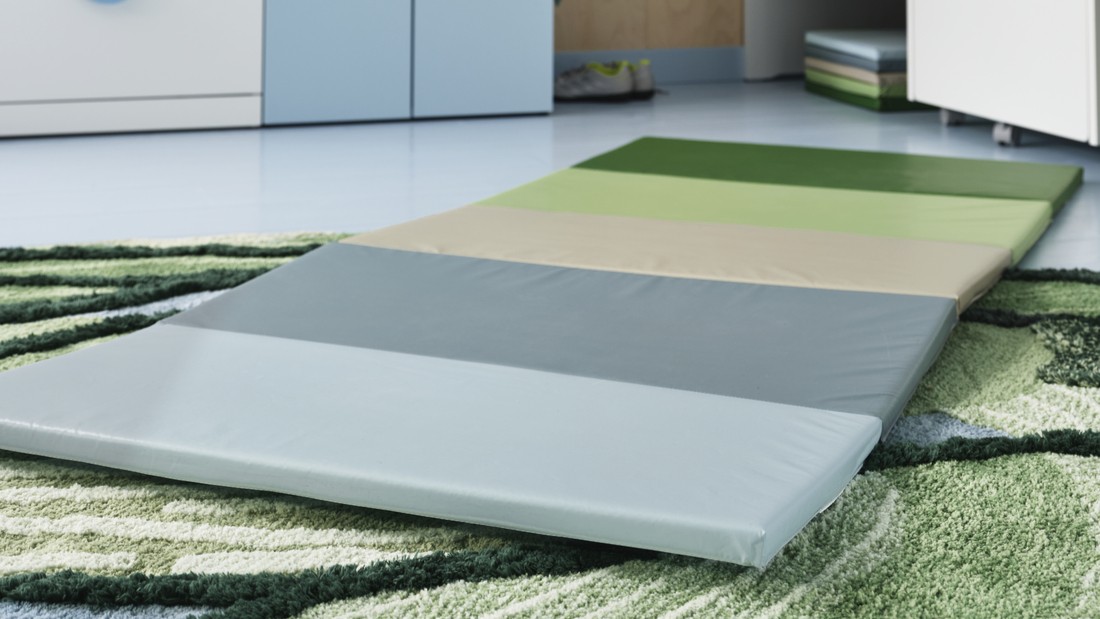
The moments when babies begin moving their hands, rolling over, and attempting to crawl always bring new experiences for parents. However, hard or cold floors can sometimes make you feel concerned and consider a more comfortable play mat to accompany your little one's activities.
This is where a baby playmat can become a useful accessory. Besides providing a dedicated play area, this mat helps you create an enjoyable exploration corner for your baby, whether in the bedroom or living room.
How do you choose one, and what type of product suits your child's developmental stage? Explore the following guide and recommendations.
A playmat is a mat used by babies or children during activities on the floor. Choose one based on age, material, play area size, and product usage instructions.
What is a baby playmat?
A baby playmat is a mat designed to provide a play surface for babies and children. These products come in various forms, ranging from fabric rugs and foam mats to foldable mats with attractive patterns and colors.
Its main function is to help create a more comfortable and organized play area on the floor. Some models include additional elements such as textures, pictures, or touchable features that encourage babies to explore their surroundings.
Baby play mats are also often referred to as baby play rugs or activity mats. Although the terms playmat and playmate are sometimes used interchangeably in searches, they have different meanings because playmate actually refers to a "play companion."
What is the difference between a baby playmat and a play gym?
Although they are often considered the same, playmats and play gyms have different characteristics. A playmat focuses on providing a surface for floor activities, while a play gym generally features a frame or arch with hanging toys that can attract a baby's attention.
A playmat is suitable if you want to provide a space for tummy time, playing together, and exploring toys. Meanwhile, a play gym is an additional option when babies begin showing interest in reaching for hanging or moving toys.
You can adjust your choice according to your baby's developmental needs, room size, and the play activities you want to enjoy together.
Benefits of baby playmats for everyday activities
Choosing a play mat is not just about cute patterns or attractive colors. Playmats also offer several practical uses that can support your child's play routine at home.
1. Providing an area for tummy time
Tummy time is an activity that involves placing a baby on their stomach while they are awake and supervised by an adult.
This activity gives babies opportunities to try lifting their heads, moving their arms, and strengthening the muscles involved in motor development.
An age-appropriate playmat can help provide a dedicated area for this activity. Make sure the mat is placed on a flat floor, is not overly soft, and is used according to the product's safety instructions.
Start with short sessions that match your baby's comfort and abilities. If you have questions about motor development or tummy time activities, consult a pediatrician.
2. Helping babies explore colors and textures
Babies learn about their surroundings through sight, touch, hearing, and interactions with people around them. Therefore, play mats featuring colors or tactile elements can provide engaging exploration experiences.
You can introduce animal pictures, encourage your baby to touch sections with different textures, or talk about the colors visible on the rug. Simple activities like these provide opportunities to develop two-way communication from an early age.
Choose age-appropriate play elements and ensure that all parts of the product are in good condition before use.
3. Providing space for movement practice
As babies grow, they begin trying various new movements, such as rolling over, reaching for toys, sitting, and crawling. An organized play area helps provide space for these activities.
Make sure hard objects, cables, furniture with sharp corners, and small items that could be swallowed are kept out of your child's reach. Play mats can improve comfort during movement, but they cannot prevent every risk of impact or falls.
4. Making play areas easier to organize
You do not need a separate playroom to provide an activity space for your little one. A sufficiently spacious corner of the living room can also be used as a play area.
Use a playmat to define the activity area, then store toys in baskets or boxes that adults can easily access. This way, you can prepare play equipment when needed and return the room to its original function afterward.
5. Creating opportunities to play together
Playtime does not always require a lot of equipment. Sitting or lying near your baby, talking to them, and showing age-appropriate toys can be enjoyable activities.
You can also invite family members to take turns interacting with your little one. A playmat helps provide a place to enjoy time together while maintaining your child's comfort and safety.
Read also: 10 inspiring ideas for comfortable and creative children's playrooms at home.
Types of baby playmats for different activities
Every family has different needs and room conditions. Understanding the types of play mats will help you choose a product based on its function rather than just its appearance.
1. Fabric playmats with sensory elements
This type usually uses textile materials with a soft surface and may feature pictures or interactive elements. Examples include textured sections, elements that produce sounds when touched, or details that babies can explore.
Fabric play rugs can be an option for sensory activities and interactions with parents. Pay attention to how easy they are to wash and the recommended age stated on the product label.
2. Foam playmats or foldable mats
Foam mats generally have a thicker structure and are available in foldable designs. This type can be considered for movement activities for older children, depending on each product's design and age recommendations.
The advantage of foldable models is their convenient storage. Once playtime is over, the mat can be folded and placed in a suitable storage area.
3. Play rugs with educational patterns
Rugs featuring roads, animals, geometric shapes, or scenery can also become part of play activities. Their patterns can be used for storytelling or imaginative games as children grow older.
However, ordinary decorative rugs are not necessarily designed as activity mats for babies. Always check the recommended age, materials, surface stability, and product instructions before use.
Tips for choosing a baby playmat that suits your needs
Before purchasing a play rug, there are several factors you should consider. The following considerations help match the product to your child's age and your home's conditions.
1. Match the mat to your child's age and activities
Newborn babies and active toddlers have different needs. For babies, you can consider mats designed for lying down and supervised sensory exploration.
As children grow, their play needs may develop into crawling, walking, and more active movements. At this stage, an age-appropriate activity mat can become an additional option.
Do not assume that all children's mats can be used from birth. The manufacturer's age recommendations should be one of your main references.
2. Choose materials and surfaces that are easy to maintain
Babies frequently come into direct contact with play mats. Therefore, cleanliness is an important factor when choosing a playmat.
Check whether the product is machine washable or only needs to be cleaned with a damp cloth. Avoid using cleaning products that are not recommended by the manufacturer because they may affect the product's materials.
Additionally, make sure there are no damaged, torn, or detached parts before your child begins playing.
3. Measure the play area before purchasing
The size of the playmat should match the available space. For smaller rooms, a compact mat may be easier to position without blocking access to furniture.
If you have a sufficiently spacious living room, a longer mat can be considered for children who need more room to move.
Leave space around the mat for supervision and adult access. Avoid placing it near stairs, frequently opened doors, or furniture that could pose a risk to children.
4. Pay attention to the mat's stability and thickness
Thickness is not the only measure of comfort or safety. Surfaces that are too soft, uneven, or easily displaced should also be considered according to the type of activity.
Check the characteristics of the mat's underside and ensure that the product sits securely on the floor. For babies doing tummy time, use a flat and sufficiently firm surface rather than a mat that allows the baby's face to sink into it.
5. Consider storage and room design
Choose a product that suits your family's habits. If the play area is located in a shared room, a foldable mat can make it easier to rearrange the space after activities are finished.
Colors and patterns can also be coordinated with the children's room decor. Nature-inspired designs, for example, pair well with light-colored wooden furniture to create a warm atmosphere inspired by Scandinavian style.
Recommended playmats and children's play mats from IKEA
IKEA offers a selection of baby playmats designed for different stages of child development. Here are two products you can consider based on age, activities, and room requirements.
1. SANDBI play rug for babies beginning to explore
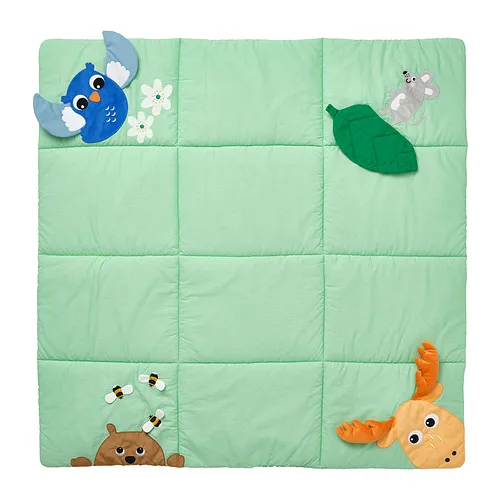
SANDBI is a 100 × 100 cm play rug featuring Scandinavian nature-inspired patterns and various colors. This product is designed as a soft play mat for babies, with several interactive elements that can spark curiosity.
One of SANDBI's appealing features is its animal and nature-themed details. The owl's wings can produce sounds when touched, a mouse is hidden behind a leaf, and the moose's antlers can be reached and explored by babies.
These features give you opportunities to play with your baby while introducing textures, sounds, and shapes. SANDBI also uses 100% cotton as its main fabric and can be machine washed at a maximum temperature of 40°C on a gentle cycle.
This product is recommended for newborn babies and should be used on the floor under adult supervision. SANDBI is worth considering if you need:
-
A play rug for babies from birth.
-
A play mat with sensory elements.
-
Cheerful nature-inspired patterns for a baby's room.
-
A textile mat that can be washed according to its care instructions.
2. PLUFSIG foldable gym mat for active children
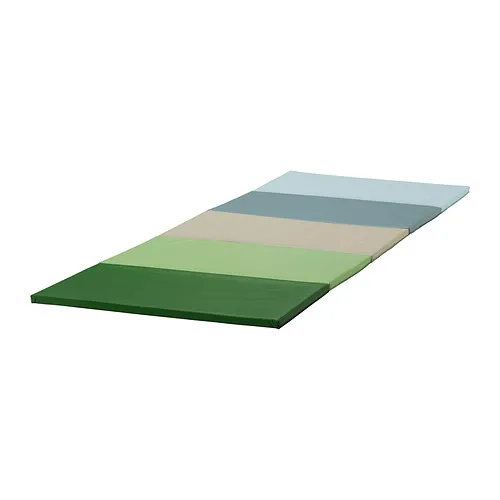
As children enter their toddler years and become more enthusiastic about moving, their play mat needs may also change. PLUFSIG is a foldable gym mat from IKEA designed for children's physical activities.
This mat measures 78 × 185 cm and is approximately 3 cm thick. Its foam padding helps provide a softer surface when children engage in activities such as rolling, moving, and practicing coordination. It can be folded flat, making it easier to store when not in use.
PLUFSIG uses polyethylene foam filling with a cover made from materials including polyester and PEVA plastic. Its surface can be cleaned with a damp cloth, while machine washing is not recommended.
Important: PLUFSIG is recommended for children over 18 months old and is intended for indoor use. This product is not recommended as a play mat for newborn babies.
Comparison of SANDBI and PLUFSIG
|
Aspect |
SANDBI |
PLUFSIG |
|
Type |
Baby play rug |
Foldable gym mat |
|
Size |
100 × 100 cm |
78 × 185 cm |
|
Recommended age |
From birth |
Over 18 months |
|
Activity focus |
Sensory exploration and play |
Movement games and coordination |
|
Main material |
Textile with cotton fabric |
Polyethylene foam with textile cover |
|
Care |
Machine wash according to instructions |
Wipe with a damp cloth |
|
Storage |
Textile rug |
Can be folded flat |
The most noticeable difference is the developmental stage of the intended users. If you are looking for a rug for a baby who is just beginning to explore their surroundings, SANDBI is more relevant because of its age recommendation.
On the other hand, PLUFSIG can be considered when your child is over 18 months old and needs an additional mat for physical activities at home.
Read also: Decorating a children's play area at home to encourage your little one's creativity.
Ideas for arranging a baby playmat area at home
You do not need a large room to create a comfortable play corner. With the right arrangement, a simple space can become a place where babies explore various new experiences.
Create a play corner near the family area
Placing a playmat in the family area can help you accompany your child during activities. Choose a section of the floor that is flat, clean, and away from frequently used walkways.
Keep the mat away from electrical cables, small objects, unstable furniture, and items that could fall. Make sure adults can supervise all of the baby's activities without furniture obstructing their view.
Use only as many toys as needed
Not all toys need to be placed on the playmat at once. A few age-appropriate toys are enough to encourage babies to interact and try different activities.
You can rotate the types of toys periodically to keep play experiences varied. For younger babies, simple interactions such as talking and showing toys are often more relevant than providing too many objects.
Prepare a dedicated storage area
Baskets and storage boxes can help you keep the play area organized. Place toys that are not being used in a separate area away from the mat.
For older children, returning toys to their designated places can also be introduced as part of the play routine. Choose storage solutions that are stable and appropriate for your child's age.
Find additional ideas through IKEA's toy storage inspiration.
How to clean and maintain a baby playmat
The cleanliness of play mats requires attention because babies frequently touch their surfaces with their hands and faces. Cleaning playmats regularly helps keep the play area comfortable to use.
Here are some maintenance habits you can follow:
-
Check the mat's surface before use to ensure there are no damaged or detached parts.
-
Remove dust, crumbs, and dirt after play activities.
-
Follow the washing instructions according to the material and product.
-
Make sure the mat is dry before using or storing it.
-
Store it in a clean, dry area away from excessive moisture.
For SANDBI, follow the machine-washing recommendation of a maximum temperature of 40°C on a gentle cycle, and avoid bleach or tumble drying. Meanwhile, PLUFSIG should be cleaned using a damp cloth and is not recommended for machine washing.
Proper care helps maintain the condition of the materials and the product's functionality during use.
Discover playmats and children's play equipment at IKEA
Every stage of child development brings different ways of playing. From discovering sounds and textures to becoming physically active, you can choose a play mat based on age, function, and comfort at home.
SANDBI can be an option for sensory experiences from birth, while PLUFSIG offers a foldable mat for activities for children over 18 months old. Adjust your choice according to your family's routine, the size of the play area, and the product's safety instructions.
Want to create a more comfortable play corner for your little one? Explore the IKEA baby toys collection and discover various inspirations on the IKEA children's world page.
Choose equipment that suits your child's developmental stage and start creating playful moments filled with curiosity together as a family.
FAQ about baby playmats
A baby playmat is a mat used for play activities on the floor. Its function is to help provide a more comfortable play surface and create an area for sensory exploration and movement according to the child's age.
The recommended age depends on the product's design and the manufacturer's recommendations. Some products, such as SANDBI, are recommended from birth, while IKEA's PLUFSIG mat is intended for children over 18 months old.
Yes, as long as the product is age-appropriate and its surface safely supports tummy time activities.
A playmat refers to a mat used for playing, while a playmate refers to a companion who plays with someone. If you are looking for a rug or mat for baby activities, the correct term is baby playmat.
Measure the available floor space and consider your child's movement needs. A 100 × 100 cm rug such as SANDBI can be considered for a baby's play corner, while a foldable mat such as PLUFSIG helps save storage space for families with toddlers who meet the recommended age requirements.