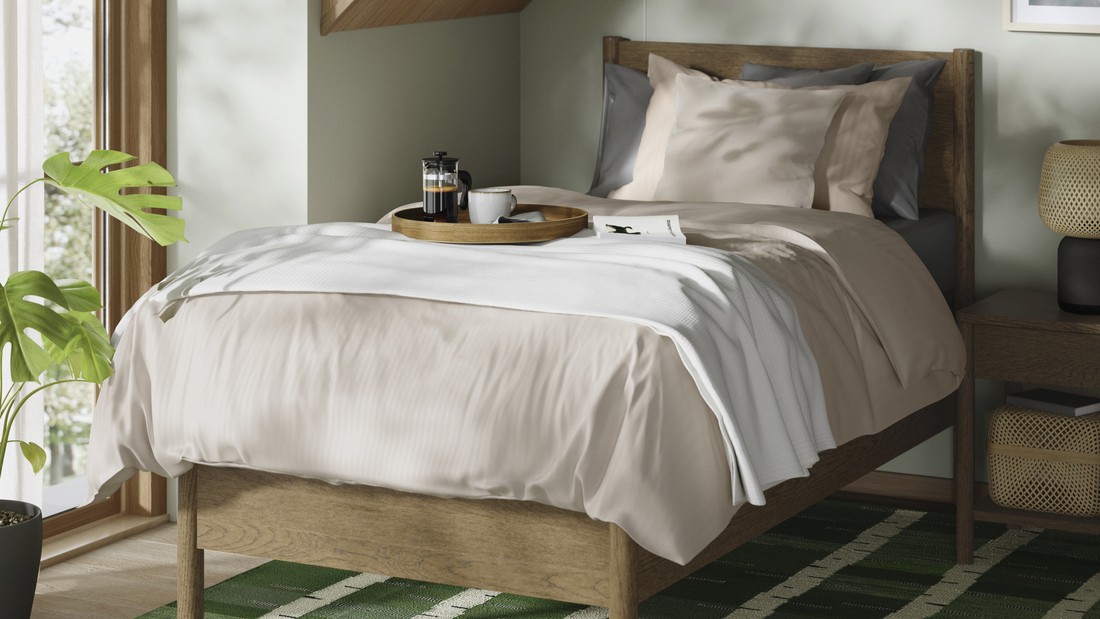
Have you ever had trouble finding your glasses, book, or phone while relaxing in bed? Small items that you frequently use before bedtime can sometimes make your bed area look cluttered because they do not have a designated place.
One way to solve this problem is by using a nightstand. Despite its relatively small size, this piece of furniture serves several functions that can help you organize your bedroom, making it feel more comfortable, practical, and enjoyable.
So, what is a nightstand, what are its functions, and how do you choose one that suits your bedroom needs? Explore the following explanation, complete with bedside table inspiration from IKEA Indonesia.
A nightstand is a small table usually placed beside a bed to store frequently needed items. Besides serving as a place for a bedside lamp, a nightstand can also feature drawers or shelves to help keep your bedroom organized.
What is a nightstand?
A nightstand is a piece of furniture in the form of a small table or low cabinet that is generally placed beside a bed.
A nightstand is also commonly known as a bedside table, a piece of furniture designed to provide an additional surface and storage space for personal belongings.
Unlike regular tables, nightstands tend to have compact dimensions, allowing them to be placed near the bed without taking up much space. They come in various designs, ranging from simple four-legged tables to models with open shelves, drawers, or cabinet doors.
In modern bedrooms, nightstands are more than just decorative accessories. This furniture also helps create a personal space beside the bed, making it easier to find the items you need.
What are the functions of a nightstand in the bedroom?
Although it may look simple, a nightstand serves various functions. Its presence can help organize your bedtime routine while providing additional space for items you frequently use.
1. Storing frequently used items
The main function of a nightstand is to provide a place to store personal belongings near the bed. This means you do not have to get up or move around just to retrieve a small item you need.
Some items you can store on a nightstand include:
-
Glasses and watches.
-
Books or magazines.
-
Alarm clocks.
-
Hand moisturizer and tissues.
-
Phone chargers.
-
Other small personal belongings.
For items you prefer to keep out of sight, a nightstand with drawers or doors can be a practical option.
2. Providing a place for a bedside lamp
A nightstand can also be used to hold a bedside lamp or reading lamp. Placing a lamp beside the bed makes it easier to adjust the lighting when reading, relaxing, or preparing for sleep.
Choose a lamp size that fits the nightstand surface so there is still room for other items. Also, pay attention to the location of electrical outlets to prevent lamp cables from crossing walking areas.
3. Helping keep the bedroom tidy
Small items placed randomly can make a bedroom feel cluttered. A nightstand provides a designated area for storing these objects, preventing personal belongings from accumulating on the bed or floor.
Models equipped with drawers can help conceal items that are rarely used. Meanwhile, nightstands with open shelves allow you to see and retrieve belongings without opening storage compartments.
4. Adding decorative elements to the bedroom
Besides providing storage, a nightstand can enhance the character of your bedroom design. Its shape, color, and materials can be coordinated with your bed, wardrobe, and other room decorations.
For example, a white nightstand can support a bright and simple bedroom atmosphere. On the other hand, a black nightstand with a metal frame can introduce an interesting modern accent.
You can also add a small decorative plant, photo frame, or vase to create a personal touch.
5. Making use of empty space beside the bed
The space beside the bed is often not used to its full potential. In fact, this area can provide additional storage without requiring a large cabinet.
For smaller bedrooms, you can use a slim nightstand or a model with multiple storage levels. These options help maximize vertical space while keeping walking areas comfortable.
Read also: Good bed placement for bedroom layouts
Types of nightstands you can choose from
Understanding the differences between nightstand models will help you determine which storage type suits your needs. Each design has characteristics that can be adapted to your bedroom size and style.
Nightstands with drawers
Nightstands with drawers are suitable if you want to store personal belongings out of sight. The drawers can be used to organize glasses, notebooks, accessories, or other small items.
This design also helps keep the tabletop looking cleaner because not everything needs to be placed on the surface.
Nightstands with open shelves
Open-shelf models provide direct access to stored items. You can place books, small baskets, or other essentials on the lower shelf.
This type of nightstand generally has a visually light appearance, making it an option for bedrooms with limited space.
Nightstands with cabinet doors
This type of nightstand features enclosed storage with a door. You can store items that are larger than those typically kept in a small drawer, depending on the cabinet's capacity.
Models with doors are also suitable if you want to maintain a simple bedroom appearance without displaying all your stored belongings.
Minimalist nightstands without enclosed storage
Minimalist nightstands generally emphasize simple shapes and practical tabletop surfaces. This model is suitable if you only need a place for a bedside lamp, clock, or a few essential items.
Because it does not have many compartments, this type also encourages you to be more selective about the belongings you place beside your bed.
What is the ideal nightstand size for a bedroom?
The size of a nightstand should be adjusted to the height of your bed, the available room space, and your storage needs. A table that is too high or too low may make items less comfortable to reach when you are sitting or lying down.
Matching the nightstand height to the mattress
In general, the nightstand surface should be level with or slightly lower than the top of the mattress. This adjustment makes it easier to retrieve items without bending too far or raising your arm excessively.
For example, if the mattress surface is 55 cm above the floor, a nightstand with a height close to 55 cm can be a starting point for consideration. However, the final choice should still be adjusted to your habits and comfort.
Considering the table's width and depth
The width and depth of a nightstand determine how much surface area is available and how much floor space it occupies.
Here are examples of dimensions based on IKEA products:
|
IKEA model |
Width × depth × height |
|
Small KNARREVIK |
37 × 28 × 45 cm |
|
Large KNARREVIK |
42 × 33.5 × 52 cm |
|
MALM with 2 drawers |
40 × 48 × 55 cm |
|
SONGESAND |
42 × 40 × 55 cm |
|
VIKHAMMER |
40 × 39 × 65 cm |
Dimensions are based on IKEA Indonesia product information. Measure the available space beside your bed before choosing.
Ensuring walking areas remain comfortable
Besides considering the table dimensions, measure the distance between the nightstand and other furniture. Make sure wardrobe doors, drawers, or bedroom doors can still be opened without obstruction.
If the nightstand is placed near an entrance or walkway, consider a slim model. This way, you can still make use of the space beside the bed without restricting movement.
IKEA nightstand recommendations for your bedroom
IKEA offers various bedside tables with different designs, sizes, and storage systems. Several of the following models were listed as available online during the search, although availability may change depending on location and purchase time.
1. KNARREVIK, a nightstand for small bedrooms
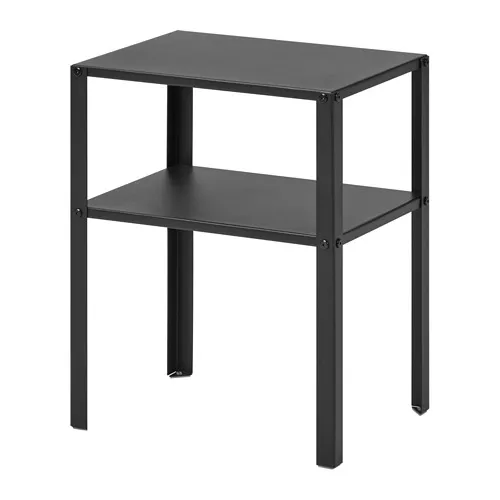
The KNARREVIK nightstand, measuring 37 × 28 × 45 cm, features a simple design with a black metal construction. This model includes an open storage area beneath the tabletop and is relatively lightweight, making it easy to move.
Its slim dimensions make KNARREVIK suitable for bedrooms with limited space, especially if you need a place for a small lamp, glasses, and books.
2. MALM, a two-drawer nightstand for additional storage
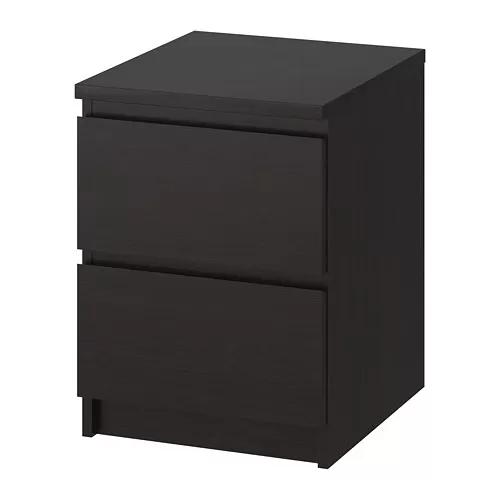
The MALM nightstand, measuring 40 × 48 × 55 cm, is a two-drawer chest that can also be used as a bedside table. Its black-brown design has a simple appearance, making it easy to coordinate with other bedroom furniture.
The two drawers in MALM allow you to separate personal belongings by category. For example, the upper drawer can be used for frequently accessed items, while the lower drawer can hold additional essentials.
3. SONGESAND, a nightstand with a door for a tidy appearance
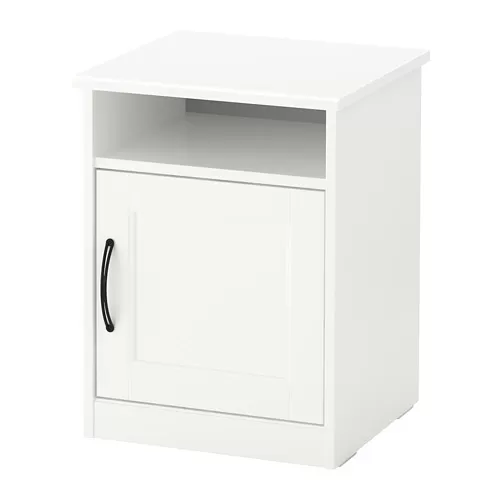
The SONGESAND nightstand, measuring 42 × 40 × 55 cm, features enclosed storage with a door that can be installed to open either to the right or left. This feature helps you adjust the table's functionality according to your bed placement.
This product also has a cable opening at the back, allowing electronic device cables to be organized more neatly.
4. VIKHAMMER, a nightstand for higher beds
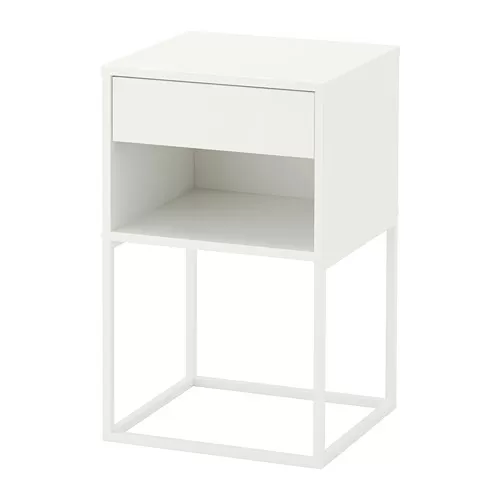
The VIKHAMMER nightstand, measuring 40 × 39 × 65 cm, features a simple design with metal legs and a drawer for storing small items. This product is equipped with a soft-closing drawer mechanism.
With a height of 65 cm, VIKHAMMER can be considered for beds with relatively high mattress surfaces. Its open shelf is also useful for placing books you want to read before bedtime.
Read also: Steps to refresh your bedroom
Tips for choosing a nightstand that suits your needs
After understanding its functions and types, the next step is to make sure the nightstand suits your daily activities. Do not focus only on its appearance, as size and storage features also affect convenience.
1. Determine which items you want to store
Pay attention to the items you usually use before going to sleep. If you only need a place for a lamp and alarm clock, a table with a simple surface may be sufficient.
However, if you want to store books, accessories, or other essentials, a model with drawers can help organize everything in one place.
2. Match the materials to your bedroom style
The materials and colors of a nightstand can influence the visual atmosphere of a room. Metal nightstands with simple lines suit modern styles, while white furniture can create a bright and clean appearance.
You do not have to use the same color for all your furniture. A combination of complementary textures and colors can also make your bedroom feel more personal.
3. Consider how easy the nightstand is to clean
Because it is located near the bed, a nightstand should be cleaned regularly to prevent dust buildup. Choose a design with easily accessible surfaces, including shelves and the area beneath the table.
Follow the care instructions according to the product's materials. Avoid leaving standing liquid on the tabletop, as it may affect the condition of certain materials.
4. Choose one or two nightstands according to your bedroom size
Using two nightstands, one on each side of the bed, can provide personal storage for two users. This arrangement can also create a balanced composition.
However, a single nightstand can provide similar benefits for individual needs. In a narrow bedroom, you can even choose a small nightstand on one side of the bed and leave the other side open.
5. Check stability and placement safety
Make sure the nightstand stands securely on the floor and is used according to the product instructions. Avoid placing heavy or fragile objects in positions where they could easily be knocked over.
If you use furniture with drawers, follow the manufacturer's assembly and safety instructions, including wall anchoring when required. This is especially important if there are children at home.
Ideas for styling a nightstand to make your bedroom more comfortable
You do not need to fill your nightstand with many decorations to make it look attractive. In fact, simple styling can leave room for essential items while keeping the bedside area feeling spacious.
Here are some ideas you can try:
-
Use a small tray. Place glasses, watches, or accessories in a tray to prevent them from getting scattered.
-
Combine a lamp with simple decorations. A bedside lamp can serve as the main element, while a small vase or photo frame adds a personal touch.
-
Arrange books vertically or in stacks. Use the lower shelf for books you frequently read.
-
Organize electronic cables. Place chargers near electrical outlets and use cable organizers to keep them out of the way.
-
Leave some surface space empty. Allow room for temporarily placing items such as glasses or a glass of water.
For more styling inspiration, you can explore IKEA bedroom ideas, from bed arrangements to decorations and storage solutions.
Mistakes to avoid when choosing a nightstand
There are several simple things that are often overlooked when choosing a nightstand. One of them is purchasing a table based on its design without first measuring the bed height and available space.
Another mistake is choosing a nightstand with insufficient storage or placing too many items on its surface. As a result, the nightstand may lose its main function as a practical storage solution.
To avoid these issues, measure the space beside your bed, check the opening direction of drawers or doors, and determine which items you want to store. By considering these factors from the beginning, you can choose a nightstand that better suits your daily habits.
FAQs about nightstands
A nightstand is generally used beside a bed to hold personal belongings needed while resting. Meanwhile, a regular side table has a broader range of functions and can be placed in a living room, beside a sofa, or in a corner of a room.
The main function of a nightstand is to provide a place to store and hold items frequently used near the bed. A nightstand can also help keep the bedroom tidy while serving as a decorative element.
No. Nightstands come in various designs, including tables without drawers, open-shelf models, and cabinets with doors.
The height of a nightstand should be close to the top surface of the mattress so that it is easy to reach when you are lying down or sitting.
A nightstand is not essential, but it can help make use of the space beside the bed. You can choose a slim model or use just one nightstand if your bedroom has limited space.
Find the right nightstand for your bedroom at IKEA
A nightstand is a simple piece of furniture that can offer practical benefits in your daily routine. From holding a bedside lamp to helping organize personal belongings, this small table can make the area beside your bed feel more practical and organized.
Before choosing one, consider your bed size, storage needs, and the bedroom style you want to create. IKEA offers various nightstand options, from slim models to drawer-equipped designs that provide additional storage.
It is time to give your bedside essentials a dedicated place. Explore the bedside table collection at IKEA.co.id and discover a design that suits your needs and bedroom character.