Not every rack suits every type of kitchen. Understanding the differences between the types helps you make a better choice and avoid regret later. Here are the types to know.
Open shelving
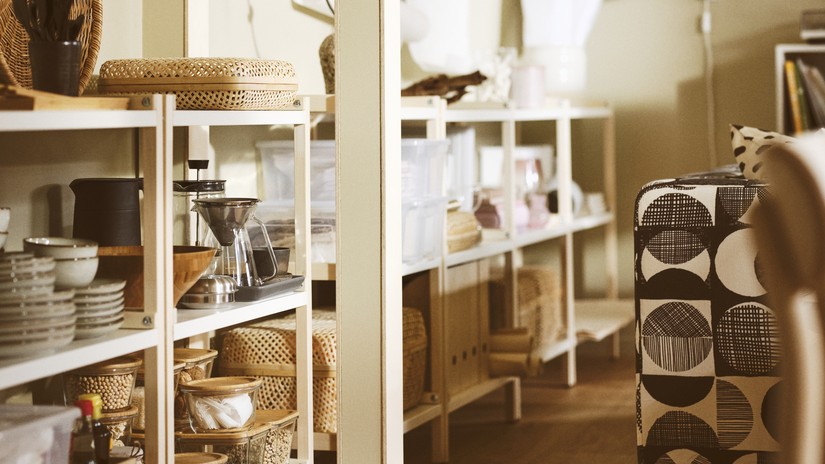
Open shelves provide easy access to all the food items stored on them. They look light and airy, making them a great fit for kitchens that want a modern feel without appearing cluttered. The key to open shelving is consistency in arrangement. Use uniform containers so the rack maintains a minimalist, tidy, and pleasing look at all times.
Racks with doors
Enclosed racks help protect food from direct exposure to air and dust. The kitchen also looks tidier since the contents are not immediately visible from the outside. This type is great for storing many items of varying sizes. Food stored inside is also better protected and its quality is better preserved.
Wall-mounted racks
Wall-mounted racks are an effective way to save floor space in the kitchen. Place them above the kitchen counter to store spices and small tools that you use frequently.
Choose a rack depth of around 15-20 cm so items are easy to reach without stretching too far. Ensure the installation is secure so the rack can safely support its load every day.
Freestanding racks
Freestanding racks offer flexibility because they can be moved at any time without drilling into walls. This makes them a practical option for apartments or rental homes with limited modifications.
They are available in various sizes, from slim single-column designs to multi-tiered options. Choose one that matches the amount of food you store and the space available in your kitchen.
Tips for choosing a rack that is sturdy, safe, and long-lasting
An attractive appearance alone is not enough when choosing a kitchen storage rack. There are several important considerations that will ensure your chosen rack can truly be relied on for the long term. Here are the tips.
Pay close attention to the weight capacity
Every rack has a maximum weight limit it is designed to support. It is important to know a rack's weight capacity before buying it, especially if you plan to store heavy items.
A rack forced to carry more than its capacity can break down quickly and become a safety hazard. Choose a rack that is strong enough and suitable for the type and quantity of items you plan to store.
Choose surfaces that are easy to clean
A smooth and flat rack surface is far easier to clean of food residue and daily dirt. Materials such as iron with a powder coating finish or wood with a neat finish are durable choices.
Choose a smooth and non-porous surface so it is easier to clean and does not absorb stains. A well-surfaced rack helps keep your kitchen hygienic and comfortable to use every day.
Make sure the structure is solid and stable
A wobbly and unstable rack can be dangerous, especially when storing items with considerable weight. Carefully inspect the rack's joints and legs before deciding to buy it.
For wall-mounted racks, ensure the brackets or supports are securely fastened to a solid wall. Stability is the main foundation for a rack that can be used comfortably over the long term.
How to arrange your rack so the kitchen always looks tidy
Having a good rack is the first step. The next step is to organize it using a system that is easy for all family members to follow.
Group items by category
Separate dry goods, canned foods, and kitchen spices into different areas. This category system speeds up searching and makes it easier for you to monitor your existing stock.
Consistency is the key. When everyone in the household knows the system in place, your kitchen rack will be much easier to keep tidy every day. Each food item will also stay in good condition without cross-contaminating one another.
Use uniform containers
Containers of similar size and shape create a cleaner and more minimalist rack appearance. Choose transparent containers so the contents are visible at a glance without opening each one.
Transferring ingredients from their original packaging also helps reduce clutter on the rack. The result is a rack that looks consistently neat every time you open it.
Add a label to each container
Simple labels help everyone find and return items to the right place. You do not need expensive labels since handwritten ones work just as well.
Place labels on the front of each container so they are easy to read from the outside. This small habit has proven to help maintain rack tidiness over a longer period.
Read also: IKEA's minimalist kitchen cabinet racks: A solution for a tidier kitchen
The right rack is the start of a kitchen you will truly enjoy